
Problem solving skills help you solve challenges every day, but they don’t always lead to success. You solve problems every single day. So why do you still feel stuck?
That question kept Ayesha awake at night. She read books. She took courses. But her career still felt frozen.
If this sounds like you, keep reading. You are not broken. You are just missing one piece.
Learn more
What Is Skill Development and Why It’s Essential in 2026
Why Smart People Still Struggle With Problem Solving Skills
Ayesha worked as a marketing manager in Lahore. She was good at her job. Her boss praised her ideas.
But every big decision left her frozen. She spent hours researching, made detailed lists, and still felt unsure.
This is common. A 2023 McKinsey study found that most employees rate problem solving as their top needed skill, yet few feel confident using it under pressure.
Knowing how to solve problems is not the same as solving them well.
Learn more
Top 10 Skills Every Freelancer Should Learn First
The Real Mistake: Solving Problems in the Wrong Order
Here is what Ayesha was doing wrong. She jumped straight to solutions.
This is the biggest gap in weak problem solving skills. People skip the most important step: understanding the problem first.
Think of it like a doctor. A good doctor does not guess. They ask questions. They run tests. Only then do they treat you.
Problem solving works the same way.
Learn more
How to Identify Your Strengths and Choose the Right Skill
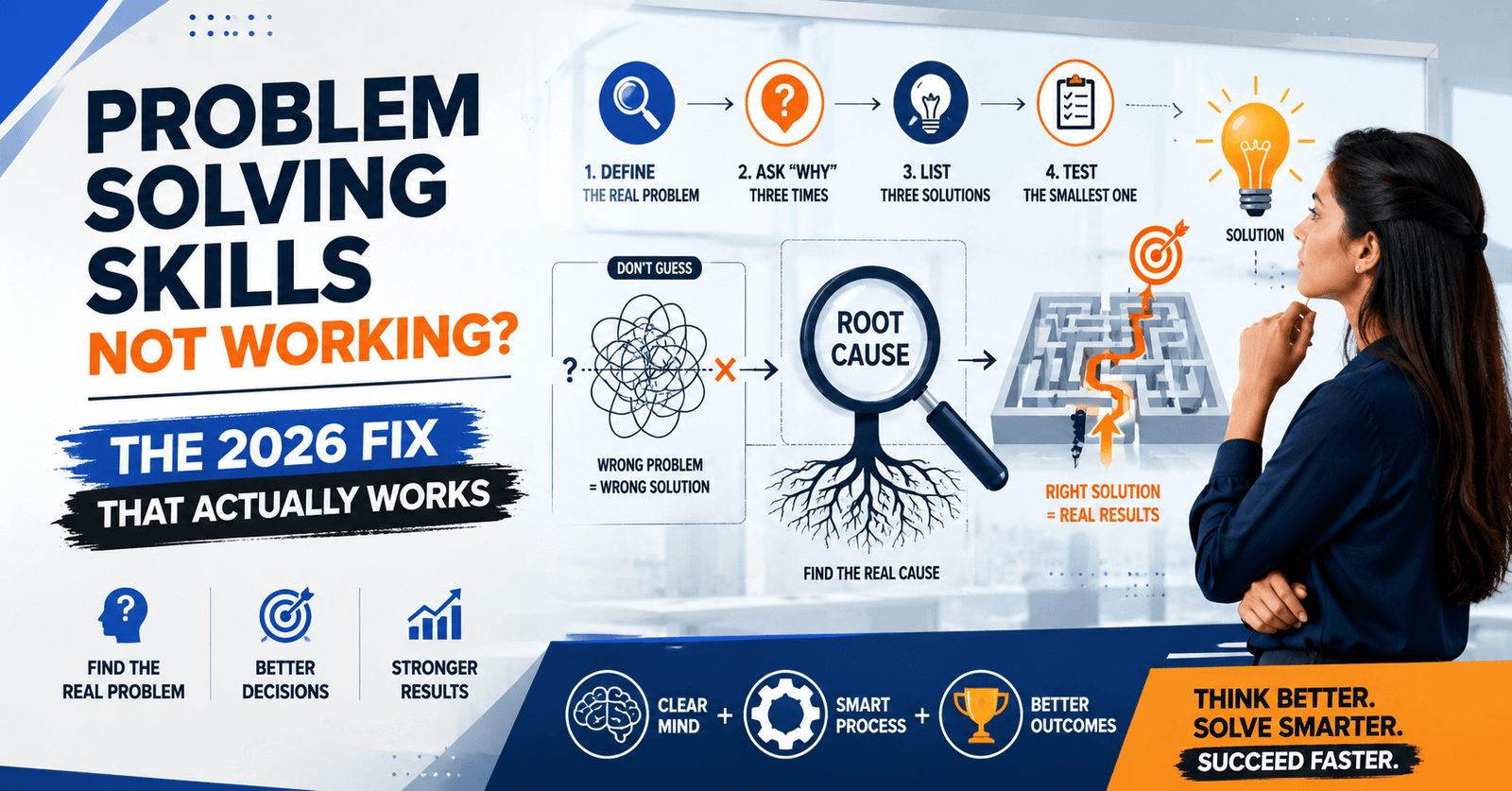
The 2026 Fix: A Simple 4-Step Method
Ayesha changed her approach. She started using a simple method. Her results changed within weeks.
Here is the method:
- Define the real problem. Write it in one clear sentence.
- Ask “why” three times. This finds the root cause, not just the symptom.
- List three possible solutions. Never settle for the first idea.
- Test the smallest one first. Small tests reduce risk and build confidence.
This method is not new. It borrows from Toyota’s famous “5 Whys” technique, used in factories for decades to find root causes fast.
Ayesha used it on a real work problem: her team kept missing deadlines.
- Old approach: Blame the team, add more meetings.
- New approach: Ask why deadlines were missed. She found the real issue — unclear task ownership, not laziness.
The fix was simple once she found the real cause. She assigned clear owners to each task. Deadlines improved by 40% in one month.
Strong Problem Solving Skills Need Emotional Control Too
Here is something most articles skip. Logic alone does not solve problems.
Stress shrinks your thinking. When you panic, your brain focuses on danger, not solutions. This is basic psychology, backed by research on the brain’s stress response.
Ayesha learned to pause before reacting. She took three slow breaths before any big decision. This small habit gave her brain space to think clearly.
Try this the next time you feel stuck:
- Pause for 10 seconds before reacting.
- Name the emotion you feel (“I feel frustrated”).
- Then return to the problem with a clear head.
This simple habit builds real problem-solving confidence over time.
How to Practice Problem Solving Skills Daily
You do not need a crisis to practice. Small daily problems are perfect training.
Try these simple exercises:
- Reframe complaints. Turn “this is broken” into “how might we fix this?”
- Solve one small problem daily. A messy inbox. A slow morning routine. Anything counts.
- Ask better questions. Instead of “why did this fail?” ask “what can I learn from this?”
Over time, these small reps build strong critical thinking skills, which work hand in hand with problem solving.
Real Results: What Changed for Ayesha
Three months later, Ayesha was a different person at work.
- She made decisions 50% faster.
- Her team trusted her more.
- She got promoted to senior manager.
Nothing about her intelligence changed. Her method changed. That made all the difference.
Conclusion: Your Problem Solving Skills Were Never the Issue
Your problem solving skills are not weak. Your process might be.
Slow down. Find the real problem first. Control your stress. Test small solutions before big ones.
Start today. Pick one small problem. Use the 4-step method. Watch what changes.
You already have what it takes. Now you have the right way to use it.
FAQs
A. Problem solving skills help you find the real cause of an issue and choose the best fix. They include thinking clearly, staying calm, and testing solutions before committing fully.
A. Stress narrows your thinking and pushes you toward quick, unclear decisions. Pausing for a few seconds before reacting helps your brain think more clearly.
A. Practice the 4-step method daily: define the problem, ask “why” three times, list three solutions, and test the smallest one first.
A. They are closely linked but not identical. Critical thinking helps you analyze information, while problem solving skills help you act on that analysis to fix real issues.
A. Problem solving skills can absolutely be learned. Like any skill, they grow stronger with regular, small practice over time.