
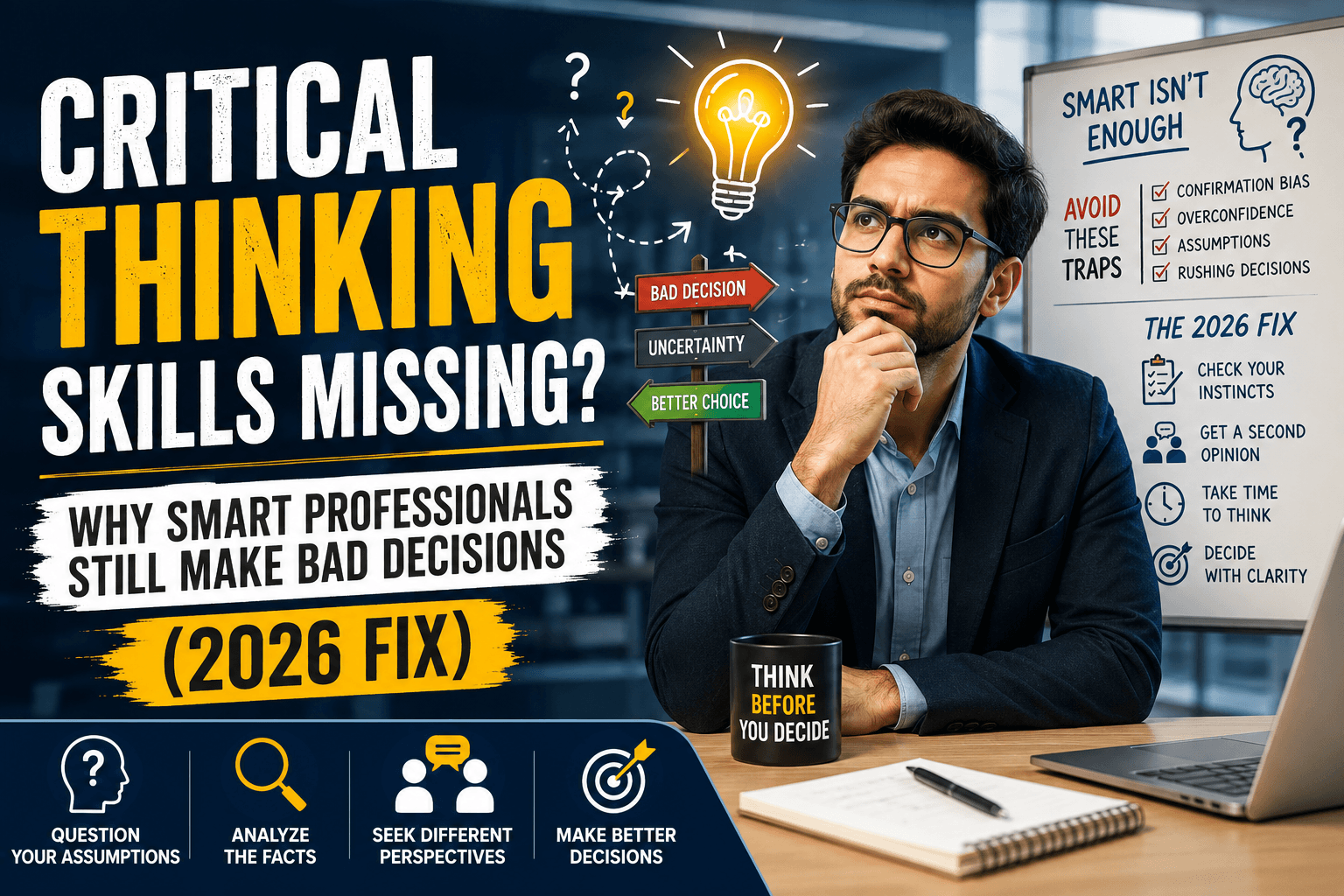
Critical thinking skills help you make better decisions, yet even smart professionals still make costly mistakes. So why did you just make another bad call?
That question haunted Faraz for months. He had a strong degree. He had years of experience. Yet his decisions kept backfiring.
If you feel smart but still second-guess every choice, this article is for you
Learn more
What Is Skill Development and Why It’s Essential in 2026
When Intelligence Isn’t Enough
Faraz worked as a finance manager in Karachi. He could crunch numbers in his head. His colleagues called him brilliant.
But last year, he approved a vendor deal without checking the fine print. The company lost money. Faraz felt confused. He was smart. How did this happen?
Research backs this up. A Cornell University study found that people with less skill in an area often overestimate their ability, while experts sometimes skip careful checks because they trust their gut too much.
Being smart and thinking critically are not the same thing.
Learn more
Leadership Development Programs Not Working? Why Freelancers Still Fail to Grow (2026 Fix)
The Hidden Mistake Behind Weak Critical Thinking Skills
Here is Faraz’s real problem. He trusted his first instinct every time.
He saw a deal. It looked good. He signed it fast. He never paused to question his own thinking.
This is the biggest gap in poor critical thinking skills. People confuse confidence with correctness. Feeling sure is not the same as being right.
Think of a pilot before takeoff. Pilots do not fly on instinct. They run a checklist every single time, even after years of experience.
Critical thinking needs the same discipline.
Learn more
Career Development Skills Not Working? Why You’re Not Growing (2026 Fix)
The 2026 Fix: A Simple Decision Checklist
Faraz changed his approach after that costly mistake. He built a short checklist for every big decision. His results improved fast.
Here is the checklist:
- State your first instinct. Write down what you initially believe.
- Ask “what would prove me wrong?” This forces you to look for opposing evidence.
- Find one outside opinion. A second perspective catches blind spots.
- Sleep on it. Big decisions rarely need to happen in the same hour.
This method echoes the “pre-mortem” technique used by psychologist Gary Klein, where teams imagine a decision has already failed and work backward to find the cause.
Faraz used this checklist on his next big vendor deal.
- Old approach: See a good offer, sign quickly.
- New approach: Question his own excitement, ask a colleague to review it, wait one day.
The colleague spotted a hidden fee Faraz had missed. That one pause saved the company thousands of rupees.
Strong Critical Thinking Skills Need Self-Awareness
Here is something most guides skip. Critical thinking is not just about facts. It is about knowing your own blind spots.
Confirmation bias makes us search for information that supports what we already believe. This is a well-documented pattern in psychology, and it affects even trained experts.
Faraz learned to notice this in himself. Before finalizing any decision, he asked: “Am I looking for reasons to agree, or reasons to think clearly?”
Try this simple habit:
- Before deciding, ask “what am I ignoring?”
- Write down one reason you could be wrong.
- Then make your final call.
This habit builds real analytical thinking skills over time, not just quick judgment.
How to Practice Critical Thinking Skills Daily
You do not need a crisis to build this skill. Small daily choices are great practice.
Try these simple exercises:
- Question the news. Ask “who benefits from this story?” before believing it.
- Debate yourself. Argue both sides of a small decision, even a simple one.
- Slow down replies. Wait five minutes before sending an important email.
Over time, these small habits sharpen your decision-making skills, which grow alongside critical thinking.
Real Results: What Changed for Faraz
Six months later, Faraz worked very differently.
- He caught two more hidden contract errors before signing.
- His team started asking him for a “second look” on their decisions.
- He earned a reputation as the most careful decision-maker in his department.
His intelligence never changed. His process did. That made the real difference.
Conclusion: Your Critical Thinking Skills Were Never Missing
Your critical thinking skills are not gone. They were just running on autopilot.
Pause before deciding. Question your first instinct. Ask for a second opinion. Give big choices time to breathe.
Start today. Pick your next big decision. Run it through the checklist. Watch how much clearer your choice becomes.
You already have the mind for this. Now you have the process to match it.
FAQs
A. Critical thinking skills help you question your own beliefs, check evidence, and make clear decisions instead of relying only on gut feeling.
A. Confidence often replaces careful checking. Smart people can trust their instincts too much and skip the step of questioning their own thinking.
A. Use a simple checklist: write your first instinct, look for opposing evidence, ask someone else’s opinion, and wait before deciding on big choices.
A. Critical thinking focuses on questioning and analyzing information. Problem solving skills use that analysis to choose and apply an actual fix.
A. Critical thinking skills can be trained through daily practice, like questioning your assumptions and debating both sides of a decision.