
Introduction
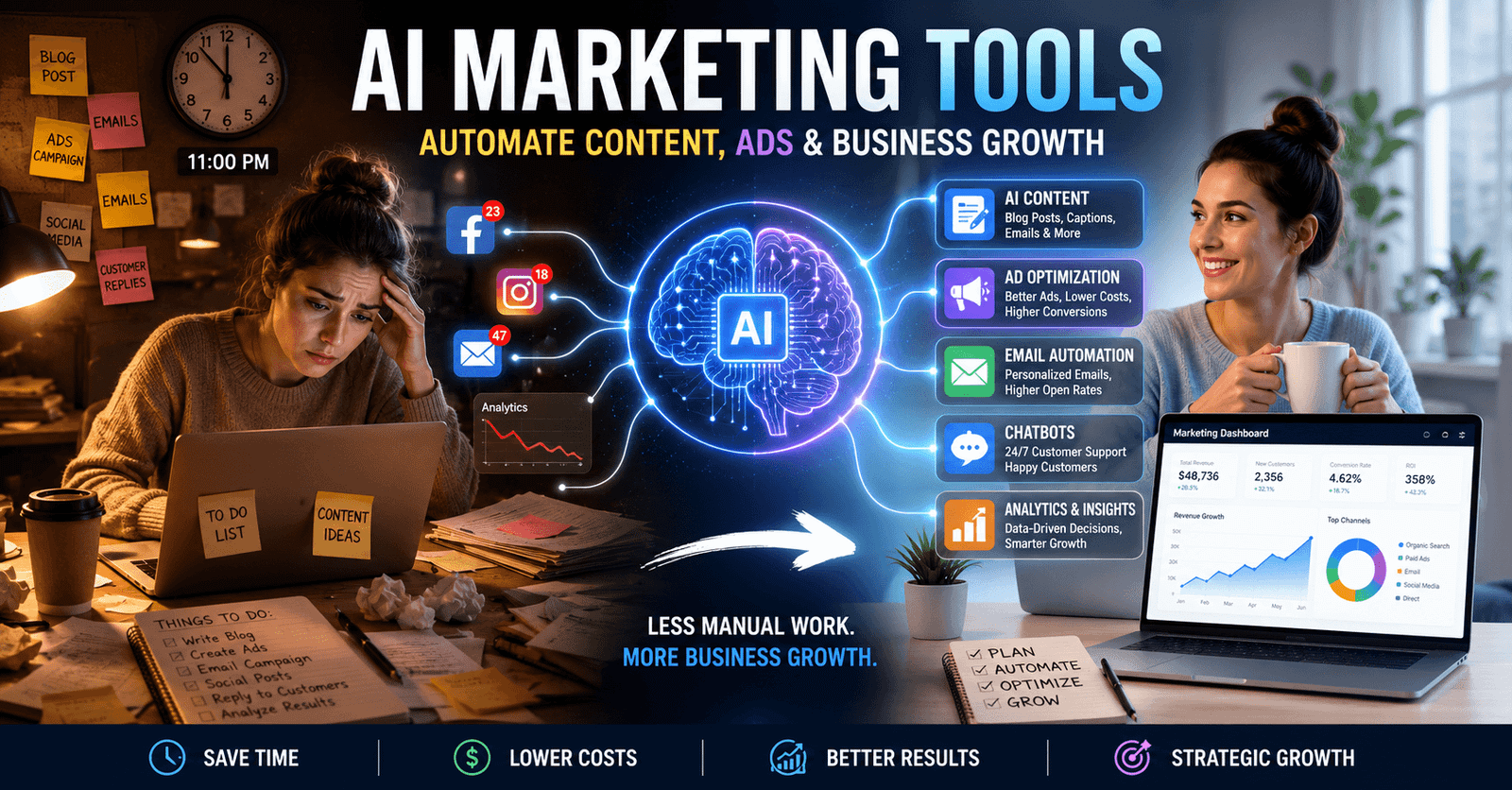
AI marketing tools are helping thousands of businesses automate content, advertising, and customer engagement in 2026, yet many entrepreneurs still work late into the night trying to do everything themselves. Working harder no longer guarantees faster growth. Working smarter does.
It is 11 p.m. Sarah is still sitting at her laptop. Her handmade candle business is growing, but her workload keeps growing faster. She spends hours writing blog posts, creating Facebook ads, replying to customer emails, and scheduling social media content. By the end of the day, she has little time left to improve her products or plan for the future.
If this sounds familiar, you are not alone. Thousands of small business owners, freelancers, and marketing teams struggle with the same challenge. Marketing has become more competitive, customer expectations are higher, and creating quality content every day feels overwhelming.
That is where AI marketing tools make the biggest difference. In 2026, these tools are no longer optional software for large corporations. They have become practical business assistants that help companies automate repetitive work, create better content, optimize advertising campaigns, personalize customer experiences, and make faster marketing decisions.
After observing how startups, ecommerce stores, local businesses, and digital agencies integrate AI into their marketing workflows, one pattern becomes clear. The businesses seeing the fastest growth are not replacing marketers with artificial intelligence. They are combining AI speed with human creativity to produce better results in less time.
In this complete guide, you will learn what AI marketing tools are, how they work, the latest AI marketing trends for 2026, practical business use cases, and proven strategies to automate content, advertising, and business growth without losing the human touch.
Learn more
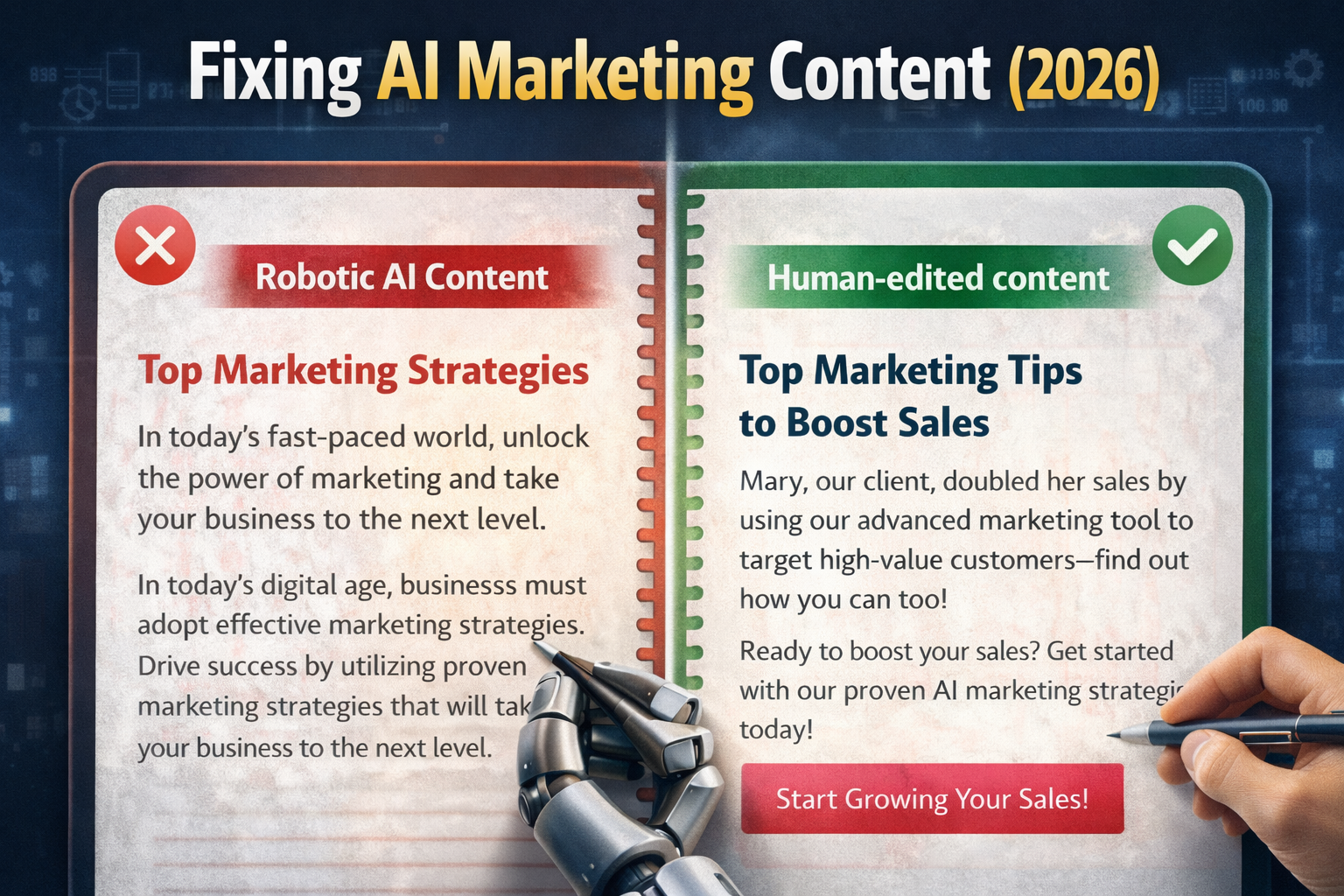
Why AI Marketing Content Sounds Robotic (And How Experts Fix It in 2026)
What Are AI Marketing Tools?
AI marketing tools are software applications powered by artificial intelligence that help businesses automate, improve, and simplify marketing activities. Instead of spending hours performing repetitive tasks manually, marketers can use AI to generate ideas, analyze customer behavior, optimize campaigns, and create personalized experiences.
Think of AI as a highly skilled marketing assistant. It works around the clock, processes huge amounts of data within seconds, and continuously learns from results. However, it still depends on human guidance for creativity, brand voice, and strategic decision-making.
Today, businesses use AI for tasks such as:
- Writing blog articles
- Creating social media captions
- Generating marketing emails
- Optimizing paid advertising
- Improving SEO content
- Building customer segments
- Creating product descriptions
- Analyzing campaign performance
Rather than replacing marketers, AI removes repetitive work so teams can focus on strategy, creativity, and business growth.
Learn more
Why AI Marketing Campaigns Fail (Real Case Study & Fixes in 2026)
Why 2026 Is a Turning Point for AI Marketing
Artificial intelligence has evolved rapidly over the last few years. Early AI tools helped with simple writing tasks, but today’s platforms assist with complete marketing workflows.
Businesses are now using AI to plan campaigns, analyze customer behavior, optimize advertising budgets, create personalized content, and predict buying trends.
According to industry research published over the past year, organizations adopting AI across their marketing operations have reported noticeable improvements in productivity, customer engagement, and campaign performance. While results vary by industry, the trend is clear: businesses that use AI effectively often respond faster to market changes and scale more efficiently than competitors relying entirely on manual processes.
Sarah experienced this shift firsthand. Instead of writing every blog article and advertisement from scratch, she started using AI to generate outlines, marketing ideas, and first drafts. Within a few months, she reduced the time spent on repetitive marketing tasks and redirected those hours toward improving her products and customer experience.
This is exactly why 2026 represents a major turning point. AI is no longer a productivity experiment. It has become a practical business advantage.
Learn more
Can AI-Written Emails Really Increase Open Rates?
How AI Marketing Tools Work
Although different platforms offer different features, most AI marketing tools follow a similar process.
Collect Marketing Data
The software gathers information from websites, customer interactions, advertising campaigns, emails, and social media platforms.
Instead of looking at isolated numbers, AI studies the complete customer journey.
Analyze Customer Behavior
Artificial intelligence identifies hidden patterns that humans may overlook.
For example, AI can discover:
- Which products sell the fastest
- Which blog topics attract the most visitors
- Which email subject lines generate higher open rates
- Which advertisements produce the best return on investment
These insights help businesses make smarter decisions instead of relying on guesswork.
Learn more
Why Most Social Media Caption AI Tools Fail to Drive Engagement
Generate Marketing Recommendations
Once the data has been analyzed, AI suggests practical improvements.
These recommendations may include:
- Better headlines
- Improved advertising copy
- High-converting keywords
- Content ideas
- Audience targeting suggestions
- Personalized email campaigns
Instead of replacing marketers, AI provides recommendations that marketers can review and improve.
Learn more
AI Advertising Tools Tested: Which One Actually Converts Better Ads?
Automate Repetitive Tasks
One of the biggest advantages of AI is automation.
Instead of manually completing repetitive activities every day, businesses can automate tasks such as:
- Email sequences
- Social media scheduling
- Content planning
- Performance reporting
- Customer support responses
- Lead qualification
This gives marketing teams more time to focus on creativity, innovation, and business strategy.
Learn more
Is Jasper AI Worth It for Real Marketing Teams in 2026?
The Biggest AI Marketing Trends Shaping 2026
Artificial intelligence continues evolving at an incredible pace. Businesses that understand these trends today will be better prepared for tomorrow’s marketing landscape.
AI Agents Are Becoming Marketing Assistants
Modern AI is moving beyond simple content generation.
AI agents can now help marketers plan content calendars, organize marketing workflows, monitor campaign performance, and recommend improvements automatically.
Instead of completing one task at a time, AI increasingly supports entire marketing processes.
Predictive Marketing Is Replacing Guesswork
Successful businesses are no longer waiting until campaigns finish before making improvements.
Predictive AI analyzes customer behavior and estimates which audiences, products, or marketing messages are most likely to generate conversions.
This helps marketers reduce wasted advertising budgets while increasing campaign efficiency.
Learn more
Can ChatGPT Really Replace Human Marketing Content?
Hyper-Personalization Is Becoming the New Standard
Customers expect brands to understand their interests.
AI makes this possible by analyzing customer behavior and delivering personalized recommendations, emails, advertisements, and product suggestions based on individual preferences.
Businesses that provide relevant experiences often build stronger customer relationships and improve long-term loyalty.
Learn more
Top Benefits of Using AI in Marketing Automation (2026 Guide)
AI Search Is Changing Content Strategy
Search behavior is evolving rapidly.
Businesses can no longer focus only on keywords. Modern AI-powered search experiences reward content that demonstrates expertise, answers questions clearly, and provides real value.
Creating helpful, trustworthy, and experience-driven content is becoming more important than ever before.
Types of AI Marketing Tools
Choosing the right AI solution depends on your marketing goals. Instead of trying every new platform, focus on tools that solve your biggest business challenge.
AI Content Creation Tools
Content marketing remains one of the most effective ways to attract customers, but creating high-quality content consistently requires time.
AI content tools help marketers:
- Generate blog post ideas
- Create article outlines
- Write product descriptions
- Draft email campaigns
- Produce social media captions
- Brainstorm marketing copy
These tools help reduce writing time while allowing marketers to edit and personalize the final content.
Learn more
How AI Is Changing Digital Marketing in 2026
AI SEO Tools
Creating content is only half the job. Businesses also need people to find it.
AI SEO tools help marketers:
- Discover keyword opportunities
- Analyze search intent
- Improve on-page SEO
- Build topic clusters
- Suggest internal links
- Optimize existing content
Instead of guessing what Google wants, marketers can make decisions based on data.
AI Advertising Tools
Paid advertising has become increasingly competitive.
AI advertising platforms improve campaigns by:
- Finding better audiences
- Testing multiple ad variations
- Optimizing bidding strategies
- Adjusting budgets automatically
- Predicting campaign performance
This helps businesses reduce wasted ad spend while improving conversions.
Learn more
What Are AI Marketing Tools? A Beginner’s Guide
AI Email Marketing Tools
Email marketing continues to deliver one of the highest returns on investment.
AI helps businesses:
- Write personalized emails
- Generate subject lines
- Predict the best sending time
- Segment subscribers automatically
- Improve email engagement
Instead of sending one message to everyone, businesses can create personalized customer journeys.
AI Customer Support Tools
Customers expect fast responses.
AI-powered chatbots and virtual assistants can answer common questions, qualify leads, and provide support 24 hours a day.
This improves customer satisfaction while reducing pressure on support teams.
Learn more
AI Marketing Strategy: 9 Reasons Your Campaigns Aren’t Getting Results (And How to Fix Them)
Popular AI Marketing Tools Businesses Are Using in 2026
Thousands of businesses now use AI every day. The best platform depends on your goals, budget, and workflow.
Popular categories include:
Content Creation
- ChatGPT
- Jasper
- Copy.ai
SEO Optimization
- Surfer SEO
- Clearscope
- MarketMuse
Email Marketing
- Mailchimp AI
- Klaviyo AI
Advertising
- Google Ads AI
- Meta Advantage+
Design & Creative
- Canva AI
- Adobe Firefly
You do not need every platform. Start with one or two tools that solve your biggest challenge before expanding your AI marketing stack.
How AI Marketing Tools Drive Business Growth
Artificial intelligence is not only about saving time.
It creates opportunities for long-term growth.
Better Productivity
Marketing teams complete repetitive tasks faster, allowing more time for planning and creativity.
Improved Customer Experience
AI delivers personalized recommendations based on customer interests, making every interaction more relevant.
Smarter Business Decisions
Instead of relying on assumptions, marketers can use AI insights to improve campaigns based on real customer behavior
Better Return on Investment
Optimized advertising, personalized emails, and smarter content strategies help businesses maximize every marketing dollar.
A Simple Business Case Study
Let’s return to Sarah’s candle business.
Before using AI, she spent nearly twenty hours every week managing marketing tasks.
Her weekly schedule included:
- Writing blog posts
- Creating Facebook advertisements
- Designing Instagram captions
- Sending promotional emails
- Responding to customer questions
Despite working late every evening, she struggled to keep up.
She decided to introduce two AI marketing tools.
One helped create content outlines and email drafts.
The second optimized her advertising campaigns.
After four months, Sarah’s weekly marketing workload dropped from nearly twenty hours to around six hours.
More importantly, she finally had time to improve her products, respond to customer feedback, and launch new collections.
Her business grew because AI reduced repetitive work—not because AI replaced her expertise.
Best Practices for Using AI Marketing Tools
Businesses achieve the best results when AI supports their existing marketing strategy.
Follow these best practices:
- Start with one marketing task before automating everything.
- Always review AI-generated content before publishing.
- Keep your brand voice consistent.
- Use AI to improve productivity, not replace creativity.
- Monitor campaign performance regularly.
- Continue testing different marketing strategies.
- Protect customer data and respect privacy regulations.
The businesses seeing the greatest success use AI as a partner rather than a replacement.
Common Mistakes to Avoid
Many businesses become disappointed because they expect AI to solve every marketing problem automatically.
Avoid these mistakes:
- Publishing AI-generated content without editing.
- Ignoring your brand’s personality.
- Depending entirely on automation.
- Choosing software based only on popularity.
- Measuring activity instead of business results.
Remember, AI can improve execution, but strategy still comes from people.
How to Choose the Right AI Marketing Tool
Every business has different goals.
Before investing in any AI solution, ask yourself:
- Which marketing task consumes the most time?
- Do I need content creation, SEO, advertising, or email automation?
- Does the software fit my budget?
- Can my team learn it quickly?
- Will it integrate with my existing workflow?
The right tool is the one that solves your biggest business challenge—not necessarily the one with the most features.
Conclusion
AI marketing tools have become essential for businesses that want to compete in 2026. They help marketers automate repetitive work, improve content quality, optimize advertising campaigns, personalize customer experiences, and make smarter decisions based on real data.
Sarah’s journey reflects what many entrepreneurs experience today. Success no longer depends on working longer hours. It depends on building better systems.
Start with one AI marketing tool that solves your biggest marketing challenge. Learn how it fits into your workflow, measure the results, and expand gradually. Businesses that combine artificial intelligence with human creativity will be in the strongest position to grow, adapt, and succeed in the years ahead.
Frequently Asked Questions
AI marketing tools are software applications that use artificial intelligence to automate marketing tasks such as content creation, SEO, advertising, email marketing, customer support, and campaign analysis.
Yes. Many AI marketing platforms offer affordable plans for startups and small businesses. They help reduce manual work, improve productivity, and support business growth without requiring a large team.
No. AI improves efficiency by automating repetitive tasks and analyzing data, but human marketers are still essential for creativity, strategic planning, branding, and customer relationships.
AI can automate blog writing, email campaigns, social media scheduling, advertising optimization, keyword research, customer segmentation, chatbot responses, reporting, and content planning.
Choose a tool based on your business goals, budget, ease of use, integration options, and the marketing challenges you want to solve. Start with one solution, measure the results, and expand your AI toolkit as your business grows.

One thought on “AI Marketing Tools in 2026: The Ultimate Guide to Automating Content, Ads & Business Growth”