
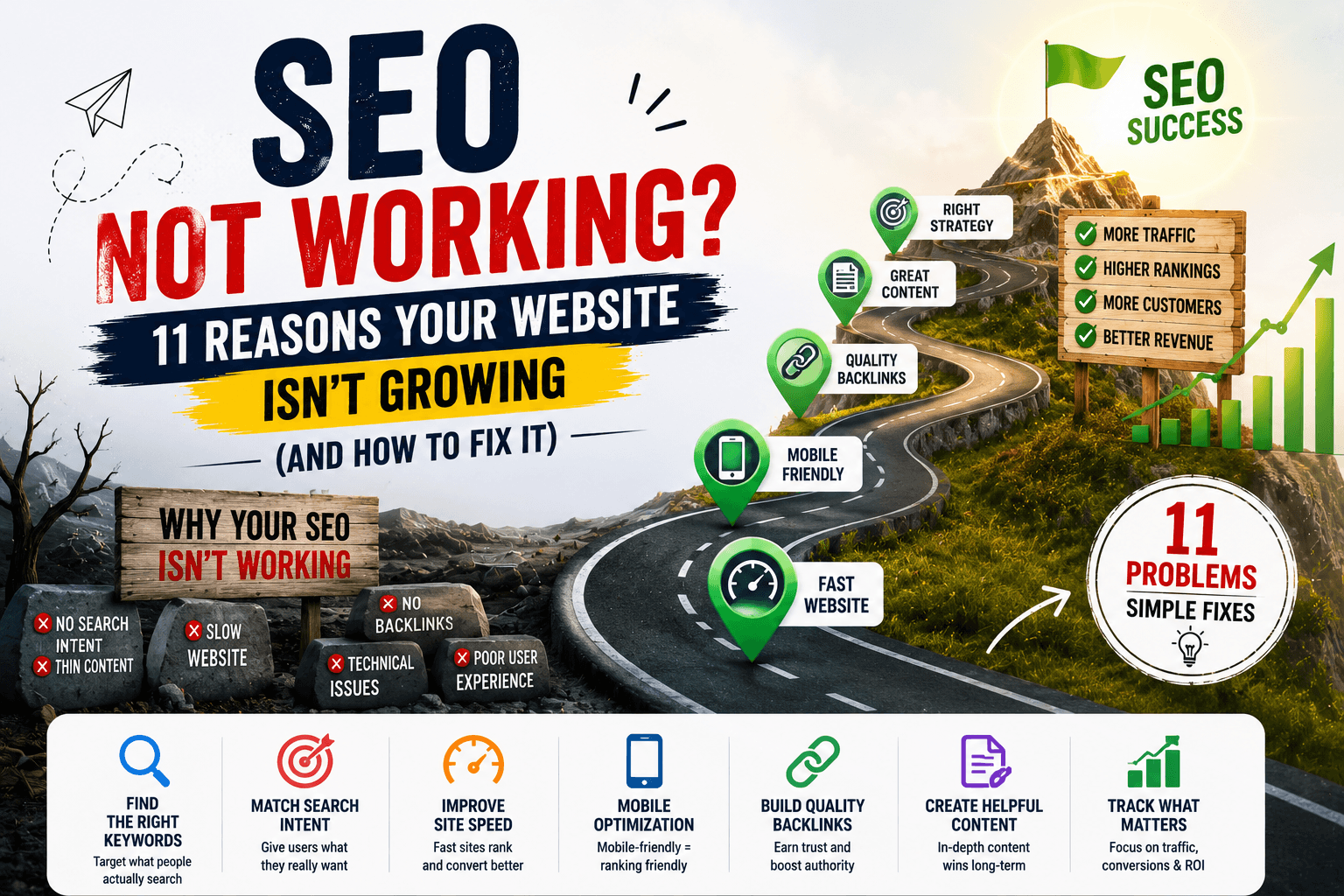
SEO not working feels like running on a treadmill that never moves. You publish content, follow the checklists, and wait. Weeks pass. Your traffic barely changes.
A business owner named Faisal knew this feeling well.He ran a growing online store and published fresh blog posts every week.He carefully added keywords throughout his content, following every SEO checklist he could find. However, traffic stayed flat for six straight months despite all his efforts.
Faisal almost gave up on SEO completelyInstead of giving up, he reviewed his entire SEO strategy step by step.During the audit, he uncovered 11 hidden mistakes that were quietly holding his website back.At first, none of the mistakes seemed serious. However, together they significantly reduced his website traffic and slowed its overall growth.
This article breaks down the same 11 reasons that held Faisal’s website back. By the end, you’ll understand why your SEO might not be working and learn the simple fixes he used to finally achieve steady traffic growth.
Learn more
SEO in 2026 Complete Guide to Ranking on Google for Beginners and Small Businesses
Why SEO Not Working Is More Common Than You Think
Most website owners assume SEO failure means something dramatic went wrong. Usually, it’s the opposite.
Small, overlooked details quietly add up over time:
- Publishing content without checking real search intent
- Ignoring technical issues that slow down growth
- Expecting fast results from a naturally slow process
Faisal’s site had several of these small issues stacking on top of each other.
Learn more
Why AI Generated Content Is Failing in 2026 (And What Actually Ranks Now)
11 Reasons Your SEO Is Not Working
Here are the exact issues Faisal found, and how he fixed each one.
SEO Not Working? You’re Targeting the Wrong Keywords
Writing content for keywords nobody searches for guarantees low traffic, no matter how well it’s written.
Fix it: Check search volume before writing. Prioritize keywords real people actually search for.
2. Your Content Doesn’t Match Search Intent
Even if your page ranks for a keyword, it won’t perform well unless your content matches what users are actually looking for.
Fix it: Study the top-ranking pages for your keyword. Match their format and depth.
3. Your Site Loads Too Slowly
Slow-loading pages frustrate visitors and search engines alike.
Fix it: Compress images and reduce unnecessary scripts to speed up load times.
4. You’re Missing Internal Links
Pages without internal links are less likely to be discovered by both users and search engines.
Fix it: Link related articles to each other naturally within your content.
5. Your Site Isn’t Mobile-Friendly
Most searches now happen on mobile devices. A clunky mobile experience hurts rankings.
Fix it: Test your site on multiple devices and fix any layout or usability issues.
6. You Have Little to No Backlinks
Search engines see backlinks as trust signals. Without them, growth stays limited.
Fix it: Reach out for guest posts or partnerships to earn genuine backlinks over time.
7. Your Content Is Too Thin
Short, surface-level articles often can’t compete with detailed, in-depth competitors.
Fix it: Expand key articles with real examples, data, and clear explanations.
8. You’re Not Updating Old Content
Outdated articles slowly lose rankings as fresher content takes their place.
Fix it: Refresh your top pages every few months with updated facts and information.
9. Your Site Has Technical Errors
Broken links, duplicate pages, or indexing issues quietly block growth.
Fix it: Run a technical audit regularly to catch and fix these hidden problems.
10. You Expect Results Too Quickly
SEO is a slow, compounding process, not an instant traffic switch.
Fix it: Set realistic timelines. Most meaningful results take three to six months.
11. You’re Not Tracking the Right Metrics
Watching only rankings hides whether your site is actually converting visitors.
Fix it: Track organic traffic, conversions, and revenue, not just keyword positions.
Learn more
How to Recover From a Sudden Google Traffic Drop in 2026 (Step-by-Step Plan)
How Faisal Fixed His SEO Not Working Problem
Faisal didn’t fix all 11 issues overnight. He worked through them gradually.
Here’s the process that worked:
- Audited his site for all 11 common issues.
- Fixed the biggest technical problems first.
- Rewrote his weakest, thinnest articles.
- Tracked traffic and conversions monthly, not just rankings.
This structured approach turned scattered effort into steady progress.
Real Results After Fixing SEO Not Working Issues
Within four months, Faisal’s website saw a clear turnaround.
- Organic traffic increased by 63%, after fixing search intent mismatches.
- Average page load time improved by 2.1 seconds, boosting user experience.
- Conversions rose by 19%, since traffic became more relevant and targeted.
These results came from comparing analytics data across two consecutive quarters.
Conclusion: Fix What’s Really Behind SEO Not Working
SEO not working rarely means the strategy is broken beyond repair. It usually means a few small, fixable issues are quietly holding your site back.
Start with one fix, like checking search intent or speeding up your site.
Like Faisal, you can turn months of flat traffic into steady, measurable growth.
FAQs
A. Common reasons include mismatched search intent, thin content, or technical issues slowing your site down.
A. Most websites see meaningful improvement within three to six months after fixing key issues.
A. Yes. Slow load times, broken links, and indexing errors can quietly block growth, even with great content.
A. Yes. Backlinks remain a strong trust signal, and a lack of them can limit how far your rankings can grow.
A. Track organic traffic, conversion rate, and revenue. These numbers show whether SEO is actually driving business results.