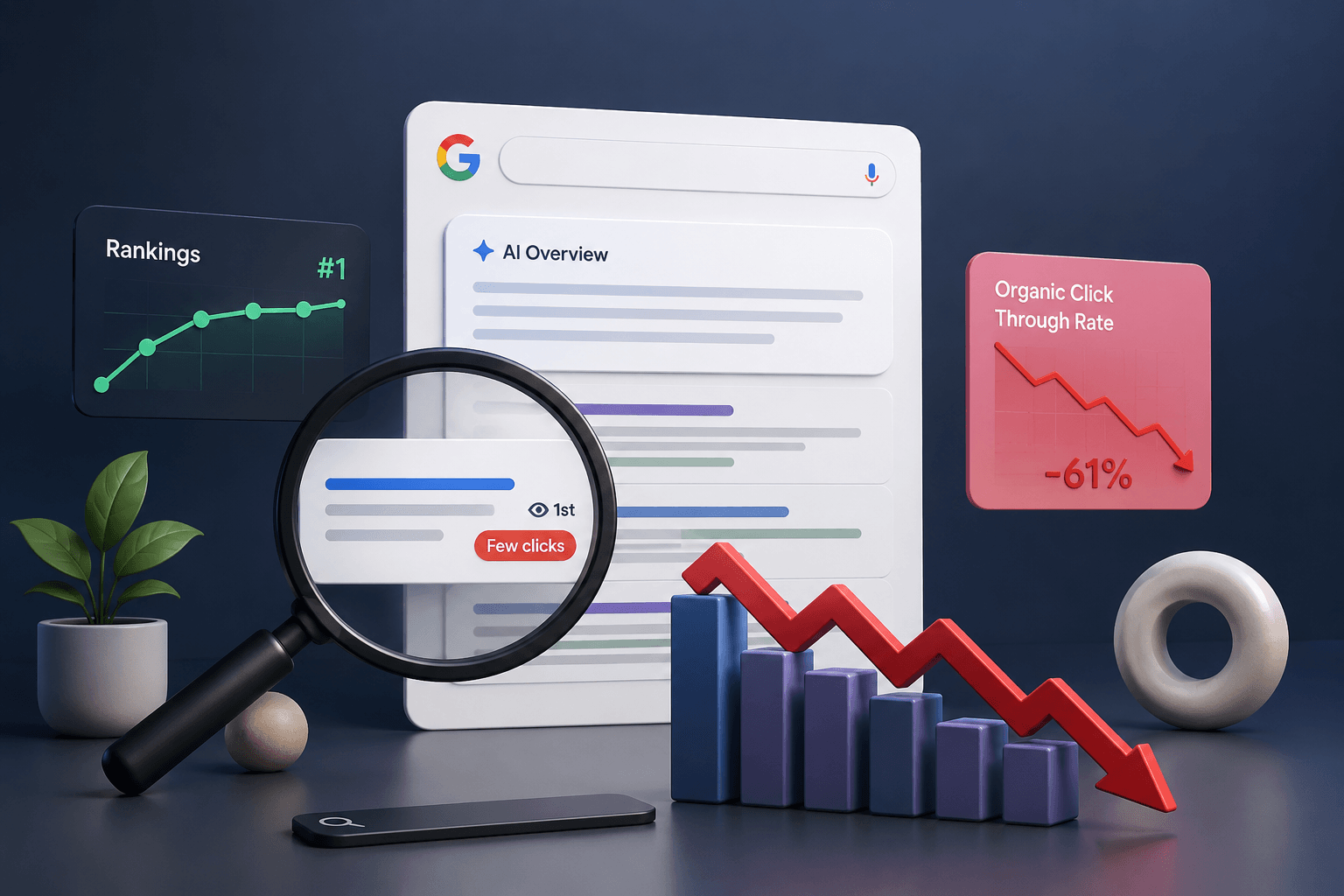
Organic click through rate can quietly collapse even while your rankings look perfectly healthy. You check Search Console. Position one, just like last year. Then you check your actual traffic, and it’s a fraction of what it used to be.
An SEO manager named Sameer knew this confusion well. His site held page-one rankings across dozens of keywords. His traffic still dropped month after month. Nothing in his rank tracker explained why.
Sameer almost assumed his tracking tools were broken. Instead, he discovered the real cause wasn’t his rankings at all. It was what Google started showing above them.
This article explains exactly why organic click through rate is falling in 2026, even for well-ranked pages, and what Sameer changed to start recovering real traffic again.
Learn more
SEO in 2026 Complete Guide to Ranking on Google for Beginners and Small Businesses
Why Organic Click Through Rate Is Dropping in 2026
Rankings measure where your page sits. Click through rate measures whether anyone actually clicks it. In 2026, these two numbers have started telling very different stories.
AI Overviews now appear on roughly 48% of all Google searches as of March 2026 (Source: The Stacc, 2026), placing an AI-generated summary above every traditional organic result.
Research tracking millions of impressions found organic click through rate fell 61% on queries where an AI Overview appeared, dropping from around 1.76% down to 0.61% (Source: Seer Interactive, 2025). Even the top-ranking position isn’t protected from this shift.
Sameer’s page-one rankings hadn’t lost their spot. Google had simply started answering the question before users ever reached his link.
Learn more
Google Ranking Factors: 11 SEO Mistakes That Stop Good Content from Ranking
How AI Overviews Are Reshaping Organic Click Through Rate
Not every query loses clicks equally. Understanding the pattern helped Sameer figure out where to focus first.
Here’s what the data shows:
- A large-scale behavioral study of actual Google searches found users clicked a traditional result only 8% of the time when an AI Overview appeared, compared to 15% without one (Source: Pew Research Center, 2025).
- Zero-click searches, where users never visit any website, now account for an estimated 65 to 70% of all Google queries in early 2026 (Source: Emarketed, 2026).
- Certain topics are hit especially hard, with healthcare queries triggering AI Overviews well over half the time, alongside home and garden and general how-to content (Source: Relevant Audience, 2026).
Sameer’s site published mostly how-to and explainer content, exactly the category losing the most ground.
The Silver Lining: Citations Still Drive Real Clicks
Not every brand is losing equally. This is where Sameer found his path forward.
Brands that earn a citation directly inside an AI Overview see about 35% more organic clicks and 91% more paid clicks compared to brands that go uncited (Source: The Stacc, 2026).
This single data point reframed the entire problem for Sameer. The goal wasn’t just ranking anymore. It was earning a spot inside the AI-generated answer itself.
Learn more
AI Search Optimization Is Changing SEO in 2026 — Why Your Old Strategy Is Failing
The C.I.T.E Framework for Recovering Organic Click Through Rate
A simple way to remember what actually helps in this new landscape is the C.I.T.E framework:
- Clarity – answer the core question directly within the first two sentences
- Independent evidence – include original data, examples, or firsthand experience AI tools can’t easily replicate
- Trust signals – add clear author expertise and credible sourcing
- Extractable structure – use clean headings and lists that are easy for AI systems to parse and cite
Many SEO teams only discover this shift after noticing rankings holding steady while Search Console clicks quietly decline month after month.
How Sameer Adjusted His Strategy
Sameer didn’t chase more rankings. He restructured his existing top-performing pages.
Here’s what he changed:
- Rewrote introductions to directly answer the main question within the first two sentences.
- Added original data and firsthand examples AI systems couldn’t pull from competitors.
- Strengthened author bios and cited credible sources throughout key articles.
- Restructured content with clearer headings for easier extraction.
This shift focused his effort on earning citations, not just holding position.
What Changed After Sameer Adapted His Content
Since making these changes, Sameer noticed a gradual shift in his traffic patterns.
- Pages that gained AI Overview citations started recovering some of their lost clicks.
- Traffic decline slowed noticeably on updated pages compared to unchanged ones.
- Search Console impressions stayed high, while click quality on updated pages improved.
This mirrors what many SEO practitioners describe in 2026: brands that earn citations and build content that’s easy for both people and AI systems to parse still find meaningful upside, even as the broader search landscape shifts (Source: ALM Corp, 2026).
Conclusion: Adapt to the New Reality of Organic Click Through Rate
Organic click through rate in 2026 depends on more than ranking position alone. AI Overviews have changed what happens before a user ever reaches your link.
Start with one page, and rewrite its opening to directly answer the core question within the first two sentences.
Like Sameer, you can adapt your content for this new search landscape, and start recovering the clicks that rankings alone no longer guarantee.
FAQs
A. This usually happens because of Google AI Overviews, which display an AI-generated answer above traditional organic results. Research shows organic click through rate can fall by 50 to 61% on queries where an AI Overview appears, even for the top-ranking position.
A. As of March 2026, AI Overviews appear on approximately 48% of all Google searches, with higher rates for categories like healthcare, education, and how-to content.
A. Yes, partially. Brands that earn a citation inside the AI Overview itself tend to see meaningfully more organic and paid clicks compared to brands that are not cited, making citation-focused content strategy important.
A. The C.I.T.E framework stands for Clarity, Independent evidence, Trust signals, and Extractable structure. It outlines the four content qualities most likely to earn citations inside AI-generated search answers in 2026.
A. No. Informational, how-to, and explainer content tend to see the steepest declines, since these query types trigger AI Overviews most often, while other query types are affected less severely.