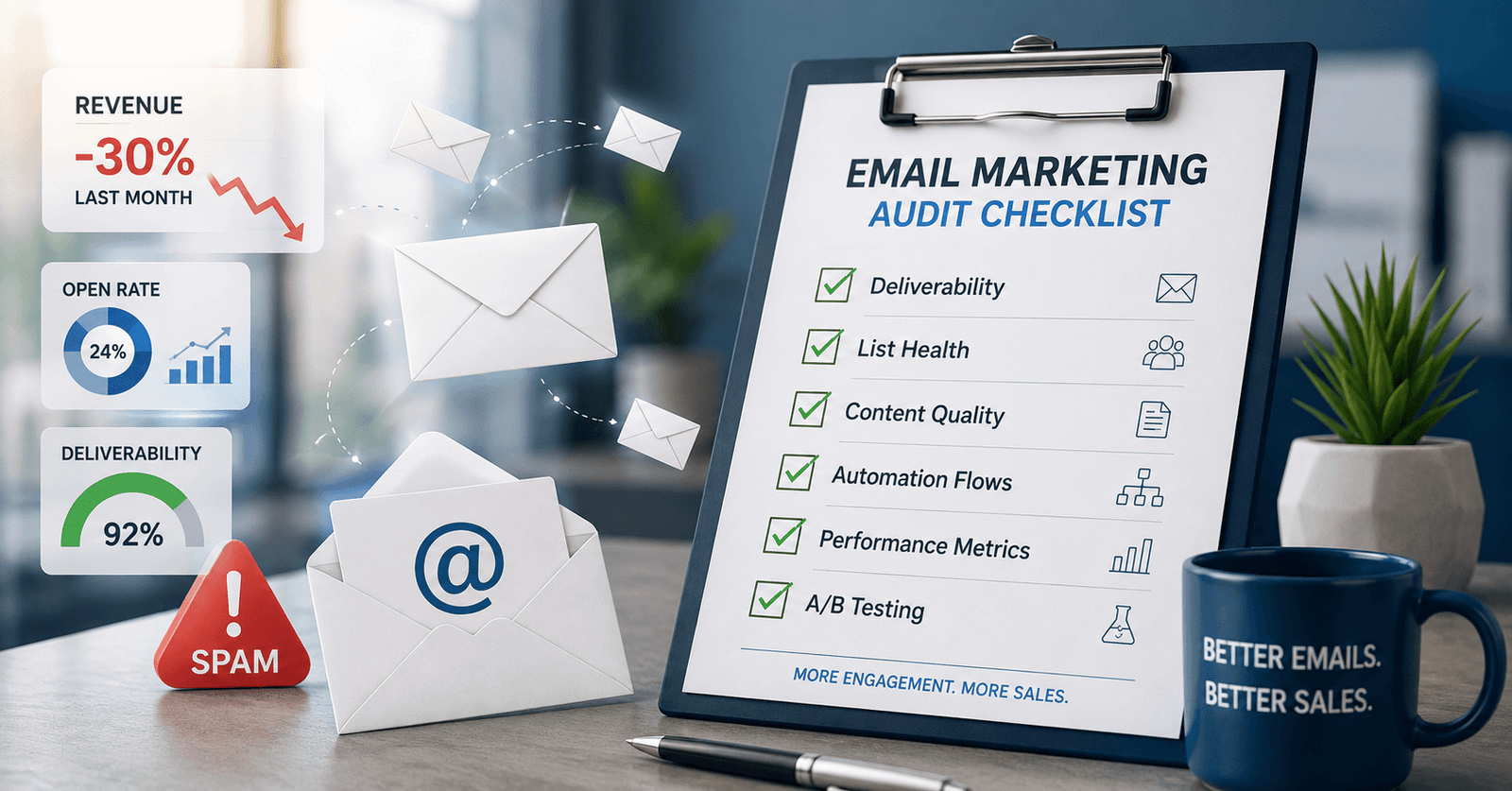
Email marketing audit can reveal hidden problems that quietly reduce your sales, even when your open rates look healthy and your email list keeps growing. So why did last month’s revenue suddenly drop by 30%? If this sounds familiar, it’s time to find out what’s really happening.
Sarah, an online store owner, faced the same problem last year. Her campaigns were going out on schedule, and her subject lines looked strong. Yet sales kept falling. She spent weeks blaming her products, pricing, and even bad luck before realizing the real issue was hidden behind the scenes.
When a marketing consultant performed a simple email marketing audit, the answer became clear. Nearly 40% of Sarah’s emails were landing in spam because of a single misconfigured email authentication setting. That one overlooked problem had been quietly costing her thousands of dollars in lost sales every month.
Stories like Sarah’s are more common than most business owners realize. Small technical issues, outdated email lists, or broken automation can slowly reduce your revenue without obvious warning signs. In this guide, you’ll learn how to perform a complete email marketing audit, identify hidden problems, and fix them before they have a bigger impact on your business.
Learn more
Email Marketing in 2026 Complete Guide from Setup to Automation and Conversions
What Is an Email Marketing Audit?
An email marketing audit is a full check-up of your email system. It looks at your deliverability, content, list health, and automation flows.
Think of it like a doctor’s check-up. Everything might feel normal on the surface. But an audit finds problems hiding underneath.
Most businesses only look at open rates and click rates. That’s not enough. A proper audit digs deeper into the numbers that actually predict sales.
Why You Need an Email Marketing Audit in 2026
Email rules have changed a lot recently. Google and Yahoo now enforce stricter spam policies. Many businesses lost visibility overnight without knowing why.
Here’s what makes 2026 different:
- Stricter spam filters from major inbox providers
- Higher customer expectations for personalized content
- More competition in every single inbox
- New privacy laws affecting how you collect and use data
If your last audit was over six months ago, your results may already be outdated.
Learn more
Best Email Marketing Platforms A Beginners Guide
Signs Your Email Marketing Needs an Audit
You don’t need to wait for a full report card to know something’s wrong. Watch for these warning signs.
Falling Open Rates Over Time
A slow, steady drop in open rates is a red flag. It often means your emails are losing trust with inbox providers.
High Unsubscribe Rates
If people are leaving your list faster than before, your content or frequency may be off. This is a clear signal worth investigating.
Low Click-Through Rates
People open your email but don’t click anything. This usually points to weak content, poor design, or confusing calls-to-action.
Sales Not Matching Email Traffic
This is the big one. If your emails get opens and clicks but sales stay flat, something is broken further down the funnel.
Learn more
Why Email Marketing Still Works in 2026
The Complete Email Marketing Audit Checklist
Here is the exact checklist to follow. Work through each section one at a time.
1. Check Your Deliverability First
Deliverability means whether your emails actually reach the inbox. This is the foundation of every successful campaign.
- Test your emails using a spam checker tool
- Verify your SPF, DKIM, and DMARC records are set up correctly
- Check your sender reputation score
- Review your bounce rate (it should stay under 2%)
Sarah’s problem, remember, was a missing DMARC record. One fix and her deliverability jumped back to normal within a week.
2. Review Your List Health
A clean list performs better than a big list. Old, inactive subscribers hurt your sender reputation.
- Remove subscribers who haven’t opened an email in 6+ months
- Check for fake or mistyped email addresses
- Confirm your list uses double opt-in
- Segment your list by engagement level
3. Audit Your Subject Lines and Content
Your subject line decides whether the email gets opened at all. Weak lines get ignored.
- Compare open rates across different subject line styles
- Check if your emails are mobile-friendly
- Read your content out loud — does it sound human?
- Make sure every email has one clear call-to-action
4. Test Your Automation Flows
Automated emails often get set up once and forgotten. Over time, links break and offers go stale.
- Click every link in your welcome series
- Check that discount codes still work
- Confirm timing between emails still makes sense
- Update any outdated product mentions or pricing
5. Analyze Your Metrics Against Industry Benchmarks
Numbers only mean something when you compare them. Here’s what healthy performance generally looks like:
| Metric | Healthy Range |
|---|---|
| Open Rate | 20–30% |
| Click Rate | 2–5% |
| Unsubscribe Rate | Under 0.5% |
| Bounce Rate | Under 2% |
If your numbers fall far below these, that section needs immediate attention.
Common Mistakes Found During an Email Marketing Audit
After running audits for dozens of businesses, a few mistakes show up again and again.
- Sending too many emails without checking engagement first
- Ignoring mobile design, even though most people read email on their phones
- Ignoring inactive subscribers, which drags down deliverability
- Skipping A/B testing on subject lines and content
- Never checking automation flows after they’re first created
How Often Should You Run an Email Marketing Audit?
A full email marketing audit should happen at least twice a year. If you’re running frequent campaigns or scaling fast, do it quarterly instead.
Small monthly checks help too. Even a quick 15-minute review of your top metrics can catch problems early.
Real Results: What Happens After a Proper Audit
Sarah’s story didn’t end with just fixing her DMARC record. Once her audit was complete, she also cleaned her list and rewrote her welcome series.
Within 60 days, her open rates rose from 12% to 27%. Her email-driven sales nearly doubled. The fix wasn’t a new strategy — it was finding what was already broken.
This is the real power of an audit. You don’t always need more emails or a bigger list. You often just need to find and fix what’s quietly holding you back.
Conclusion
A drop in sales doesn’t always mean your product or offer is the problem. Often, the real issue is hiding inside your own email system. Running a regular email marketing audit helps you catch deliverability issues, weak content, and broken automations before they cost you more money.
Start with the checklist above. Fix one section at a time. Small, steady improvements add up to real, lasting sales growth.
FAQs
A. It’s a full review of your email system, including deliverability, content, list health, and automation. It helps you find hidden problems that hurt your sales.
A. Most businesses should run a full audit twice a year. If you send frequent campaigns, a quarterly review is better.
A. Falling sales despite steady opens and clicks is the clearest sign. It usually means a problem further down your funnel.
A. Yes. Missing authentication records can send your emails straight to spam, cutting off a large part of your audience without any warning.
A. Basic tools like a spam checker and your email platform’s analytics dashboard are enough to start. Advanced audits may use dedicated deliverability tools.