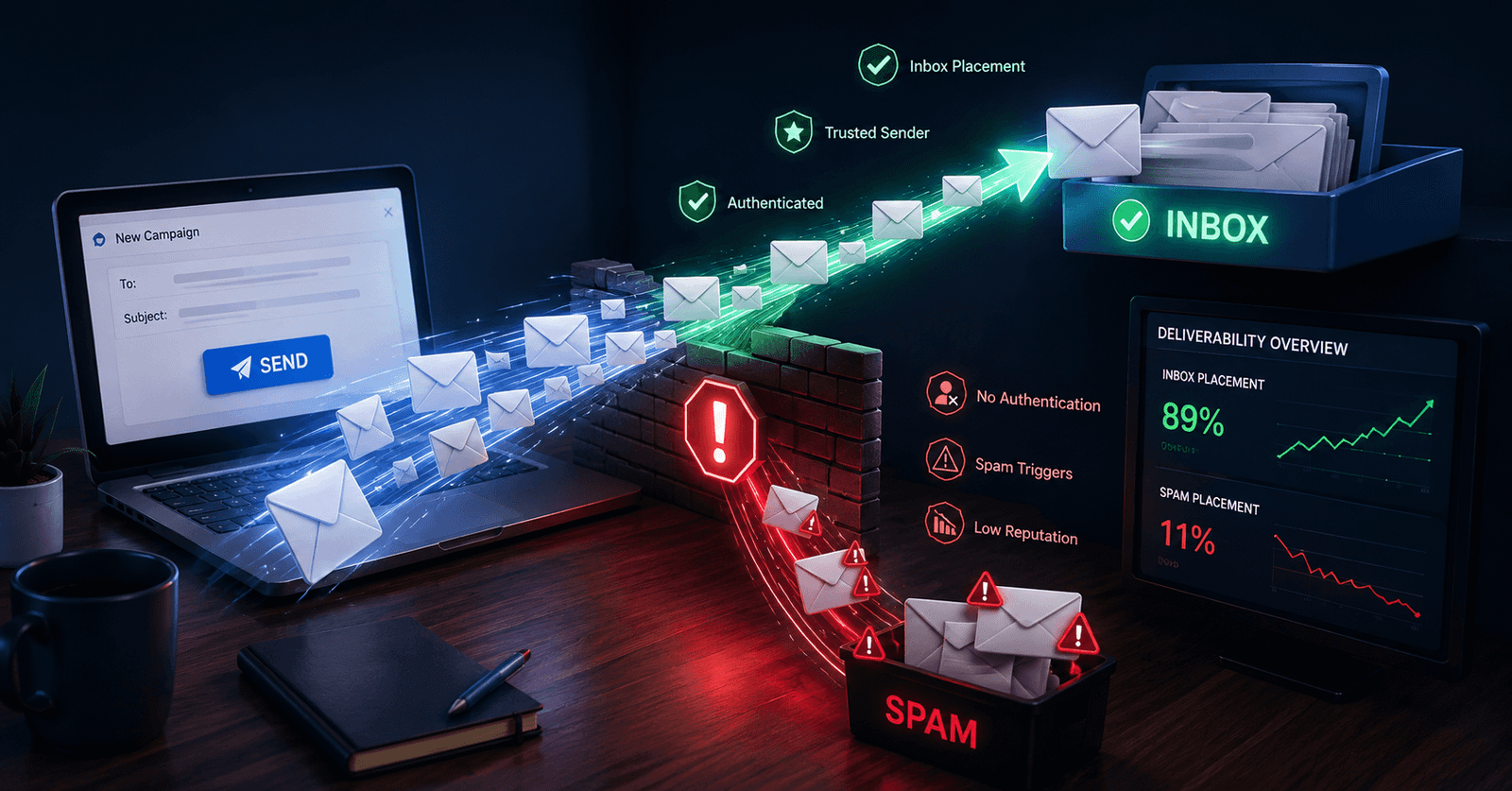
Quick summary: Poor email deliverability means emails technically send but land in spam instead of the inbox. It’s usually caused by missing authentication, list decay, or rising spam complaints. Fixing it requires proper authentication, regular list cleanup, and consistent sending habits.
Email deliverability is one of the biggest factors that determines whether your email marketing campaigns succeed or fail in 2026. Imagine sending 10,000 emails and only 3,000 people ever seeing them. No error message. No warning. Just silence.
Jenna owns a skincare brand in Austin, Texas. Her list had 15,000 subscribers. Her campaigns looked polished, and her offers were strong.
But her sales kept declining month after month. She blamed her products. She blamed the economy. Since every campaign showed as “sent successfully,” it never crossed her mind that most of her emails weren’t reaching her customers’ inboxes.
Then a deliverability expert checked her sender reputation. The truth was shocking: more than 60% of her emails were landing in spam folders, invisible to real customers.
Stories like Jenna’s happen to businesses across the United States every day. The good news is that once you understand email deliverability, you can identify the real problem, improve inbox placement, and recover lost sales.
Learn more
Email Marketing in 2026 Complete Guide from Setup to Automation and Conversions
The Problem: Why Emails Stop Reaching the Inbox
In short: Emails can be technically “delivered” while still landing in spam, because delivery and deliverability are not the same thing.
What Is Email Deliverability?
Answer: Email deliverability measures whether your email actually reaches the inbox — not just whether it was sent without bouncing.
An email can be “delivered” straight into spam. That still counts as delivered, but nobody ever sees it. Deliverability measures the real outcome: did your email land in the primary inbox, where people actually read it?
Why Email Deliverability Is Getting Harder in 2026
Inbox providers have tightened their rules. What worked two years ago can now hurt your sender reputation badly.
- Stricter spam filters from Gmail and Yahoo — providers now require stronger authentication
- Rising spam complaint sensitivity — even a small number of complaints can damage your sender score
- More competition in the inbox — providers filter aggressively to protect users from overload
Learn more
Email Marketing Funnel in 2026: How US Brands Turn 500 Leads Into Paying Clients
Signs Your Business Has an Email Deliverability Problem
In short: Slowly falling open rates, disengaged subscribers, rising bounce rates, falling sales, and increased spam complaints are the five key warning signs.
- Open rates drop slowly over several weeks or months
- Engaged subscribers stop responding, even to offers they liked before
- Bounce rates creep upward without a clear reason
- Sales fall despite steady sending volume
- Spam complaints increase, even slightly
If you notice two or more of these, it’s time to investigate.
The Solution: How to Fix Email Deliverability Step-by-Step
In short: Authenticate your domain, clean your list, monitor your sender reputation, avoid spam trigger words, and send on a consistent schedule.
Step 1: Authenticate Your Domain
SPF, DKIM, and DMARC prove to inbox providers that you’re a real, trusted sender. Most email platforms offer simple setup guides for this.
Step 2: Clean Your Email List Regularly
Remove subscribers who never open your emails. A smaller, engaged list performs far better than a large, inactive one.
Step 3: Watch Your Sending Reputation
Your sender score tells inbox providers how trustworthy you are. Check it monthly using free tools built for this purpose.
Step 4: Avoid Spam Trigger Words
Words like “free money” or “act now” in all caps can trigger spam filters. Write naturally, like you’re talking to a real person.
Step 5: Send Consistently, Not Randomly
Sudden spikes in sending volume look suspicious to inbox providers. Keep a steady, predictable sending schedule instead.
Learn more
Why Your Email Subscribers Don’t Trust You in 2026 (And How to Fix It)
Real Case Study: How Jenna Fixed Her Email Deliverability
Once Jenna learned the truth, she didn’t panic. She followed a clear, step-by-step recovery plan with her consultant.
- Set up SPF, DKIM, and DMARC records correctly for her domain
- Removed inactive subscribers who hadn’t opened an email in a year
- Warmed up her sending by gradually increasing volume again
- Switched to a dedicated IP with a trusted email provider
- Monitored her sender score weekly using a free reputation tool
Within 45 days, her inbox placement rose from 40% to 89%. Her email revenue nearly tripled the following month.
Common Mistakes That Hurt Email Deliverability
- Buying email lists instead of growing them organically
- Ignoring bounce rates month after month
- Skipping authentication setup when switching email providers
- Sending to inactive subscribers out of habit
- Never testing where emails actually land
Best Practices to Protect Long-Term Email Deliverability
Answer: Use double opt-in, segment by engagement, test before sending, monitor complaints, and keep content relevant.
- Use double opt-in to confirm genuine subscribers
- Segment your list based on engagement levels
- Test emails before every major campaign
- Monitor complaint rates closely each month
- Keep content relevant to what subscribers actually want
Conclusion
Great products and great offers mean nothing if your emails never reach real people. Poor email deliverability quietly drains sales, often without any clear warning sign. The fix starts with authentication, list health, and consistent sending habits.
Like Jenna’s skincare brand, your business can recover fast with the right steps. Start today, and watch your inbox placement, and your sales, climb back up.
FAQs
A. Email deliverability measures whether your emails actually reach the inbox, not just whether they’re sent. It’s the real test of email success.
A. Common causes include rising spam complaints, missing authentication records, or sending to too many inactive subscribers at once.
A. Use a free spam checker or sender reputation tool. Many email platforms also show inbox placement rates in their reporting dashboard.
A. Yes. A large list full of inactive subscribers often hurts deliverability more than a smaller, engaged list ever would.
A. Most businesses see real improvement within 30 to 60 days, depending on how severe the reputation damage was to start.