Your ads are working. Traffic is growing. Yet your profits still are not where you want them to be. The fastest way to increase average order value is not by spending more on advertising but by getting each customer to spend a little more on every purchase.
If this sounds familiar, you are not alone. Many ecommerce store owners focus on bringing in more visitors, believing higher traffic will solve their revenue problems. In reality, low average order value is often the hidden reason sales fail to turn into healthy profits.
Average order value (AOV) is the average amount a customer spends per order. Even a small increase can boost your revenue, improve your return on ad spend, and make every customer more valuable without increasing your marketing budget.
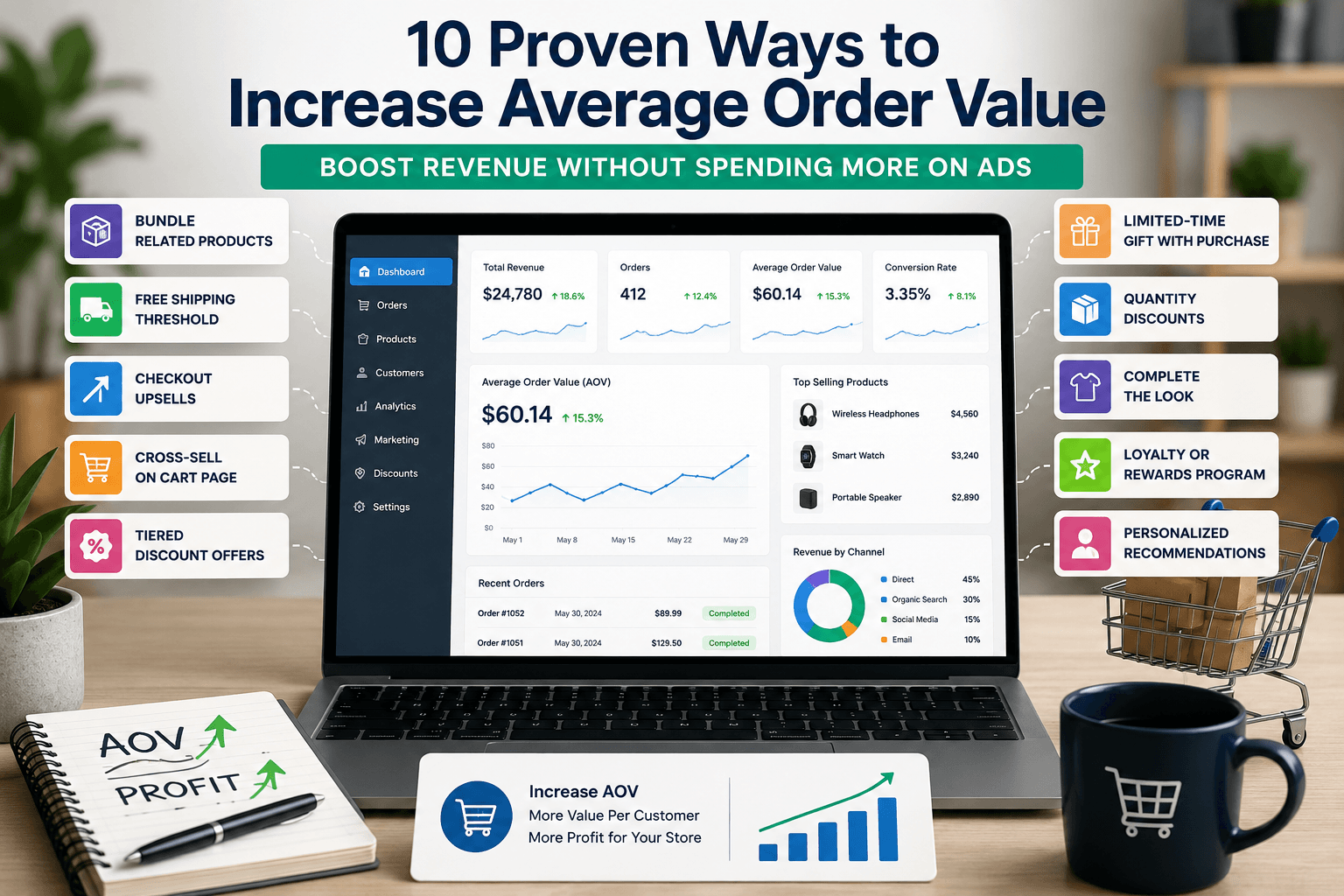
In this guide, you’ll discover 10 proven strategies to increase average order value, backed by practical examples and easy-to-implement ideas. Whether you run a small online store or a growing ecommerce business, these tactics can help you generate more revenue from the traffic you already have.
Learn more
What Is Dropshipping and How It Differs from Traditional E-Commerce
What Is Average Order Value and Why It Matters
Average order value is simple math. You take your total revenue and divide it by the number of orders.
For example, if your store made $10,000 from 200 orders last month, your average order value is $50.
Here is why this number matters so much:
- It directly increases your profit per customer
- It reduces your dependency on expensive ad traffic
- It improves your return on every marketing dollar you already spend
A small increase in average order value can create a big jump in monthly revenue. That is the power of this metric.
Learn more
Top 10 E Commerce Business Models Explained
Strategy 1: Bundle Related Products to Increase Average Order Value
Bundling means grouping two or three related products and selling them as one offer.
A skincare store, for example, bundled a face wash, toner, and moisturizer into one “Glow Kit.” Customers who bought the bundle spent 34% more than those who bought single items.
Bundles work because they feel like a smart deal, not an upsell.
How to Create a Winning Bundle
- Pick products customers already buy together
- Offer a small discount, around 10-15%
- Give the bundle a simple, benefit-driven name
Strategy 2: Set a Free Shipping Threshold to Increase Average Order Value
People hate paying for shipping. So use that dislike to your advantage.
Set a free shipping threshold slightly above your current average order value. If your AOV is $50, set free shipping at $65.
Many customers will add one more item just to unlock free shipping. This single trick alone can lift average order value by 10-20%.
Strategy 3: Use Product Upsells at Checkout to Increase Average Order Value
An upsell offers a better or upgraded version of the product a customer is already buying.
For example, if someone adds a basic blender to their cart, offer a premium version with extra features for a small price difference.
Keep upsells:
- Relevant to the original product
- Priced reasonably higher, not double
- Shown at the right moment, like on the product page or cart
Strategy 4: Add Cross-Sells on the Cart Page
Cross-selling means suggesting a different but related product.
If a customer buys running shoes, show them socks or shoe cleaner. These small additions feel helpful, not pushy.
Amazon has used this method for years with its “Frequently Bought Together” section, and it remains one of the most trusted ways to increase average order value.
Strategy 5: Create Tiered Discount Offers
Tiered discounts reward customers for spending more.
A simple structure looks like this:
- Spend $50, get 10% off
- Spend $80, get 15% off
- Spend $120, get 20% off
This gives customers a clear reason to add more items to their cart before checking out.
Strategy 6: Offer a Limited-Time Gift With Purchase
People love free gifts, especially when time is limited.
A clothing brand tested this by offering a free tote bag on orders above $75. Orders above that amount jumped by 28% during the campaign.
The key is urgency. Use phrases like “today only” or “while stock lasts” to push faster decisions.
Strategy 7: Use Quantity Discounts
Encourage customers to buy more of the same product by offering quantity-based pricing.
For example:
- Buy 1 for $20
- Buy 2 for $36
- Buy 3 for $48
This works especially well for consumable products like supplements, coffee, or skincare items that customers repurchase often.
Strategy 8: Add a “Complete the Look” Feature
This strategy works great for fashion, home decor, and lifestyle brands.
Instead of just showing one product, show the full outfit or setup. A furniture store that added a “Complete the Room” section saw customers add an average of 1.4 extra items per order.
It helps customers visualize a full experience, not just a single item.
Strategy 9: Introduce a Loyalty or Rewards Program
A loyalty program gives customers a reason to spend more today and come back later.
Simple point systems work well:
- Earn 1 point per dollar spent
- Redeem 100 points for $5 off
Customers who feel rewarded tend to increase their basket size to reach the next reward level.
Strategy 10: Personalize Product Recommendations
Personalized recommendations show products based on what a customer already viewed or bought.
E-commerce brands using AI-based recommendation engines often see average order value grow by 10-15%, because the suggestions feel relevant, not random.
Even a simple “You may also like” section, based on browsing history, can make a real difference.
Learn more
Shopify Dropshipping Not Working? Here’s Why Your Store Is Failing to Make Sales (2026)
How to Track Your Average Order Value Progress
Increasing average order value is not a one-time fix. It needs regular tracking.
- Check your AOV weekly, not just monthly
- Compare AOV before and after each new strategy
- Test one strategy at a time so you know what is actually working
Small, consistent testing beats big, random changes.
Conclusion: Grow Revenue Without Growing Ad Spend
You do not need a bigger ad budget to grow your store. You need smarter offers, better product pairing, and a checkout experience that gently encourages customers to spend a little more.
Start with one or two strategies from this list. Track your average order value closely. Once you see results, add more tactics gradually.
Small changes today can lead to steady, profitable growth tomorrow, without spending an extra dollar on ads.
FAQs
A. There is no fixed number, since it depends on your industry and product price. Focus on improving your own past average order value, not comparing it to others.
A. Yes. When each customer spends more, your return on ad spend improves automatically, even if your ad budget stays the same.
A. Free shipping thresholds and checkout upsells usually show results the fastest, often within a few weeks of testing.
A. Yes. Many strategies, like bundling or tiered discounts, can be set up manually or with basic store features, no expensive software needed.
A. Review it weekly. This helps you catch trends early and adjust your strategy before a small dip becomes a bigger problem.