
AI hallucination can turn a confident article into an embarrassing correction email. You publish a blog post. A reader points out a “fact” that never happened. Your credibility takes the hit.
This exact scare happened to a content writer named Omar. He used an AI tool to draft a research-heavy article. It sounded polished and confident. But three of the statistics it quoted didn’t exist anywhere.
Omar caught the errors just before publishing, but it shook his trust in AI writing tools. Instead of quitting AI altogether, he studied why this kept happening, and found 11 ways to prevent it.
This article breaks down exactly what AI hallucination is, why it happens, and the 11 methods Omar now uses to keep his content accurate and trustworthy.
Learn more
Best AI Powered Writing Assistant: The Complete 2026 Guide to AI Writing Tools and How They Work
What Is AI Hallucination, and Why Does It Happen?
AI hallucination happens when an AI tool generates information that sounds true but isn’t. It might invent a statistic, a quote, or even a study that never existed.
This happens because AI models predict likely word patterns, not verified facts. They aim to sound convincing, not to fact-check themselves.
Omar realized his AI tool wasn’t lying on purpose. It simply didn’t know the difference between a real source and a plausible-sounding guess.
Learn more
Emotional Copywriting: Why AI Writing Tools Struggle (And How Marketers Solve It)
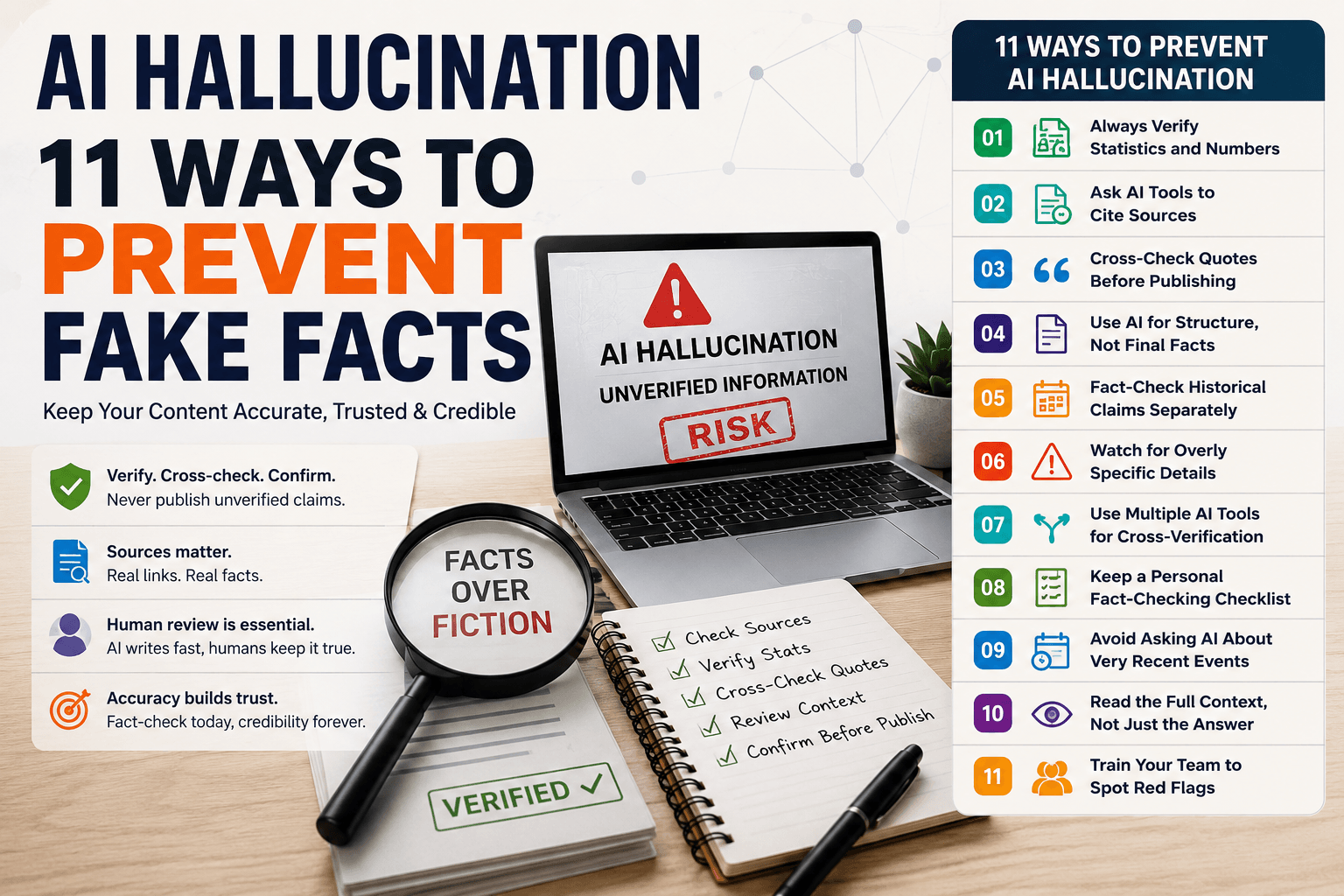
11 Ways to Prevent AI Hallucination in Your Writing
Here are the exact methods Omar now uses before publishing any AI-assisted content.
Method 1: Always Verify Statistics and Numbers to Prevent AI Hallucination
Never trust a number without checking it against a real source first.
Search the exact figure separately to confirm it exists and matches the context.
2. Ask AI Tools to Cite Sources
Requesting sources makes it easier to check if claims are real or invented.
If the AI can’t provide a real link, treat the claim as unverified.
3. Cross-Check Quotes Before Publishing
AI tools sometimes attribute quotes to people who never said them.
Search the exact quote to confirm who actually said it, and where.
4. Use AI for Structure, Not Final Facts
Let AI help organize your article, but pull real facts from trusted sources yourself.
This reduces how much unverified content ends up in your final draft.
5. Fact-Check Historical Claims Separately
Dates, events, and historical details are common hallucination targets.
Confirm any historical claim using a reliable reference, not just the AI’s answer.
6. Watch for Overly Specific Details
Extremely precise numbers or names can be a red flag for invented information.
If a detail feels suspiciously exact, verify it before trusting it.
7. Use Multiple AI Tools for Cross-Verification
Different AI tools sometimes generate different “facts” for the same question.
If two tools disagree, that’s a signal to research the claim manually.
8. Keep a Personal Fact-Checking Checklist
A simple checklist helps you catch hallucinations before publishing.
Include steps like verifying stats, quotes, and named sources every time.
9. Avoid Asking AI About Very Recent Events
AI models often guess when asked about events after their training data ends.
For anything recent, search the web directly instead of relying on the AI’s memory.
10. Read the Full Context, Not Just the Answer
Sometimes AI mixes correct facts with invented details in the same sentence.
Read each claim carefully instead of trusting the overall tone of confidence.
11. Train Your Team to Spot Red Flags
If you work with a team, teach everyone the common signs of AI hallucination.
Shared awareness catches more mistakes than relying on just one editor.
Learn more
How Writers Fix AI Writing Tools That Generate Repetitive Paragraphs
How Omar Built a Simple AI Hallucination Fact-Checking Workflow
Omar didn’t apply all 11 methods to every sentence. He built a simple, repeatable process instead.
Here’s what his workflow looks like now:
- Generate a first draft using AI.
- Highlight every statistic, quote, and named source.
- Verify each highlighted item individually.
- Only publish once every claim is confirmed.
This process adds a little time, but it protects his credibility every single time.
Real Results After Reducing AI Hallucination
Since building this workflow, Omar has seen major improvements.
- Zero factual corrections needed across his last 20 published articles.
- Reader trust increased, based on positive comments about accuracy.
- Editing time dropped by 25%, since his checklist made fact-checking faster and more focused.
These results came from tracking his published articles over a six-month period.
Conclusion: Protect Your Content From AI Hallucination
AI hallucination isn’t a reason to avoid AI writing tools. It’s a reason to build a smart verification habit around them.
Start with just one method, like verifying every statistic before publishing.
Like Omar, you can enjoy the speed of AI writing while keeping your content accurate, trustworthy, and hallucination-free.
FAQs
A. It’s when an AI tool generates information, like a fact or quote, that sounds real but isn’t. This can happen even with advanced AI writing tools.
A. AI models predict likely word patterns instead of verifying real information. This can lead to confident-sounding but false claims.
A. Search any statistic, quote, or named source separately to confirm it exists and matches what the AI generated.
A. Yes. Recent events, exact statistics, and specific quotes are common areas where AI tools tend to generate inaccurate information.
A. Not entirely, but consistent fact-checking habits can catch nearly all hallucinated claims before publishing.