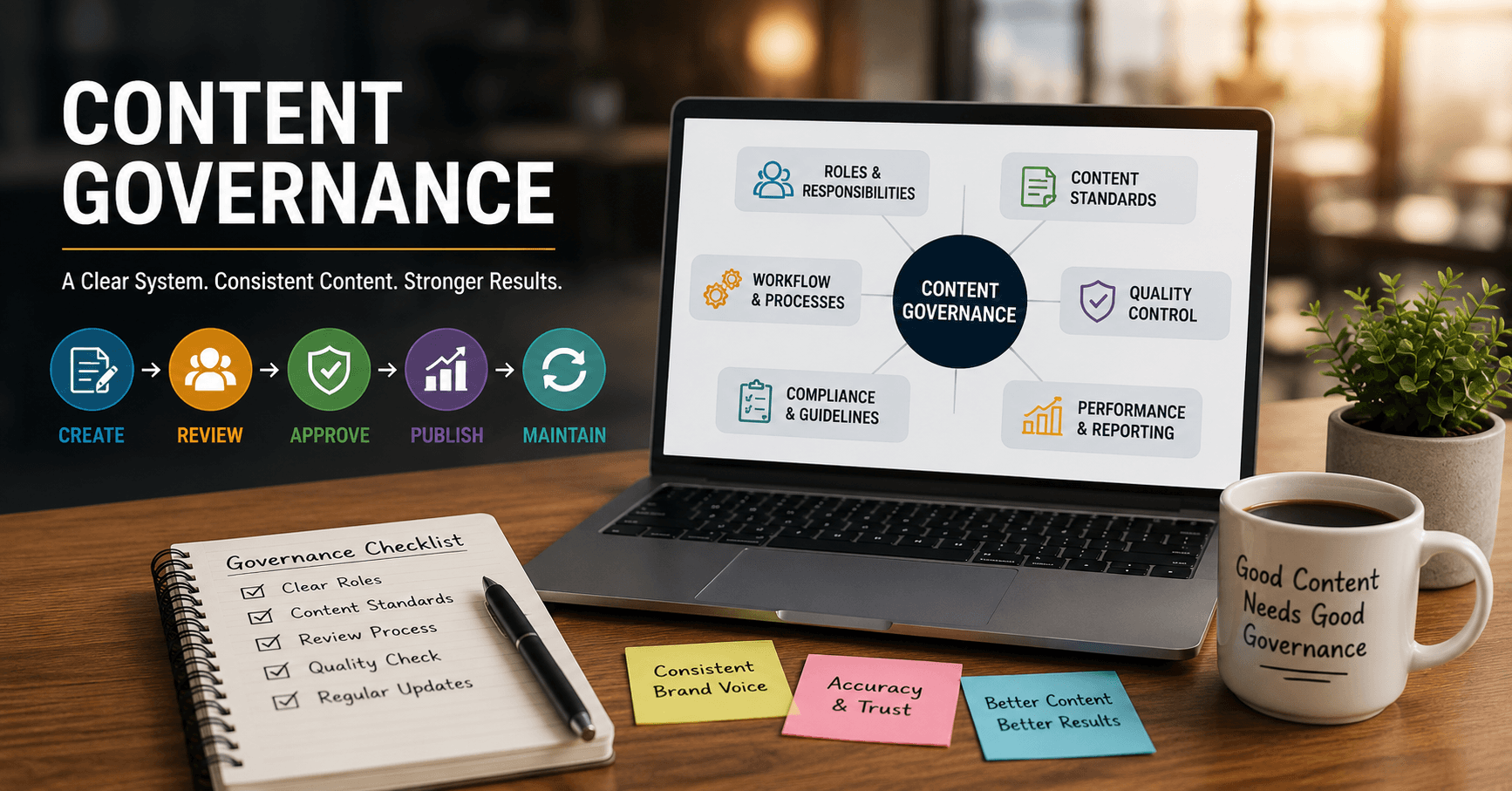
Content governance becomes essential as your content team grows. Without clear processes, content quality can quickly become inconsistent, approvals get delayed, and outdated information creates confusion.
Farrukh, a marketing director, faced this exact challenge after his team grew from three people to fifteen. Instead of hiring more editors, he discovered the real problem was the lack of a structured content governance framework.
In this guide, you’ll learn how to build a simple content governance system that improves consistency, streamlines approvals, and helps your team publish high-quality content at scale.
Learn more
Content Marketing in 2026 (Complete Strategy Guide That Actually Works for Traffic & Sales)
Why Content Governance Becomes Critical as Businesses Grow
Small teams can rely on informal habits and shared memory. Growing teams can’t.
Here’s what typically breaks down without a clear system:
- Inconsistent tone and quality across different writers
- Duplicate or conflicting content on the same topics
- No clear ownership over reviews, updates, or approvals
Farrukh’s team had talented writers, but no shared rules guiding how their work fit together as a whole.
Learn more
AI Content Is Flooding the Internet in 2026 Why Your Content Is Getting Ignored
Core Elements of a Strong Content Governance Framework
A content governance framework doesn’t need to be complicated to be effective.
Here’s what it typically includes:
1. Clear Content Ownership
Without defined owners, content quietly falls through the cracks.
Build this: Assign a specific owner for each content category, responsible for quality and updates.
2. Documented Style and Brand Guidelines
Inconsistent tone confuses both readers and search engines about your brand identity.
Build this: Create a shared style guide covering tone, formatting, and common terminology.
3. A Defined Review and Approval Process
Unclear approval steps lead to bottlenecks or unreviewed content going live.
Build this: Map out exactly who reviews content, and at which stage, before publishing.
4. A Content Audit Schedule
Old content quietly becomes outdated or contradictory without regular review.
Build this: Set a recurring schedule, like quarterly, to review and update existing content.
5. Version Control and Documentation
Without tracking changes, teams lose visibility into what changed and why.
Build this: Keep a simple log of major content updates, including dates and reasons.
6. Access and Permission Structure
Too many people editing live content without oversight increases the risk of errors.
Build this: Define who can create, edit, and publish content at each stage.
Learn more
Your Content Looks Good But Still Fails in 2026? The Trust Problem Explained
The F.R.A.M.E Model for Content Governance
A simple way to remember the core structure is the F.R.A.M.E model:
- Framework – documented guidelines everyone can reference
- Roles – clear ownership for each content area
- Approval – a defined review process before publishing
- Maintenance – scheduled audits to keep content current
- Evaluation – regular checks on whether the system is actually working
Many growing teams only build a system like this after facing a public inconsistency, like conflicting information published on two different pages.
How Farrukh Implemented This Framework
Farrukh didn’t overhaul everything at once. He introduced the framework in stages.
Here’s the order he followed:
- Assigned clear content owners for each major topic area.
- Documented a shared style guide within one week.
- Mapped out a simple two-step approval process.
- Scheduled quarterly audits for the site’s top-performing content.
This gradual rollout let his team adjust without feeling overwhelmed by sudden new rules.
What Changed After Implementing Content Governance
Since building this framework, Farrukh noticed a clear shift in how his team operated.
- Content inconsistencies became far less common, since ownership was clearly defined.
- New writers ramped up faster, since guidelines were documented instead of relying on memory.
- Outdated content stopped quietly lingering, thanks to the recurring audit schedule.
This reflects what many content operations leaders describe: governance doesn’t slow teams down, it prevents the chaos that naturally comes with rapid, unstructured growth.
Conclusion: Build Content Governance Before You Need It
Content governance often gets ignored until problems already exist. Building a simple framework early prevents the confusion that naturally comes with growth.
Start with one piece, like documenting clear ownership for your most important content areas.
Like Farrukh, you can turn a chaotic, inconsistent content operation into a system that scales smoothly as your team grows.
FAQs
A. Content governance is a system of rules, roles, and processes that guides how a business creates, reviews, approves, and maintains its content. It matters most as teams grow past two or three people, because informal habits that worked for a small team break down once more writers, editors, and stakeholders get involved, leading to inconsistent tone, duplicate content, and unclear ownership.
A. A business should start building a content governance framework as soon as more than one or two people are regularly creating content, rather than waiting until inconsistencies, contradictions, or missed updates become visible problems. Acting early, before the team scales further, prevents the cleanup work that comes with retrofitting structure onto an already chaotic content operation.
A. No, content governance does not typically slow down production. A clear framework usually speeds up content creation by removing confusion about who owns a topic, who approves it, and what standards it should meet, which are the exact bottlenecks that waste time in ungoverned content operations.
A. The F.R.A.M.E model is a five-part structure for content governance: Framework (documented guidelines), Roles (clear content ownership), Approval (a defined review process), Maintenance (scheduled content audits), and Evaluation (regular checks on whether the system is working). It gives growing teams a simple, memorable structure to build their governance process around.
A. The simplest first step is documenting clear ownership for each major content category, pairing it with a basic style guide covering tone and formatting. This single step, assigning a named owner to each content area, resolves the most common governance failure: content with no one responsible for its quality or accuracy.
A. Quarterly audits work well for most growing businesses, since this frequency catches outdated statistics, broken links, and contradictory claims before they accumulate. High-priority or high-traffic pages may benefit from more frequent review, such as monthly, given their larger impact on overall site credibility.