
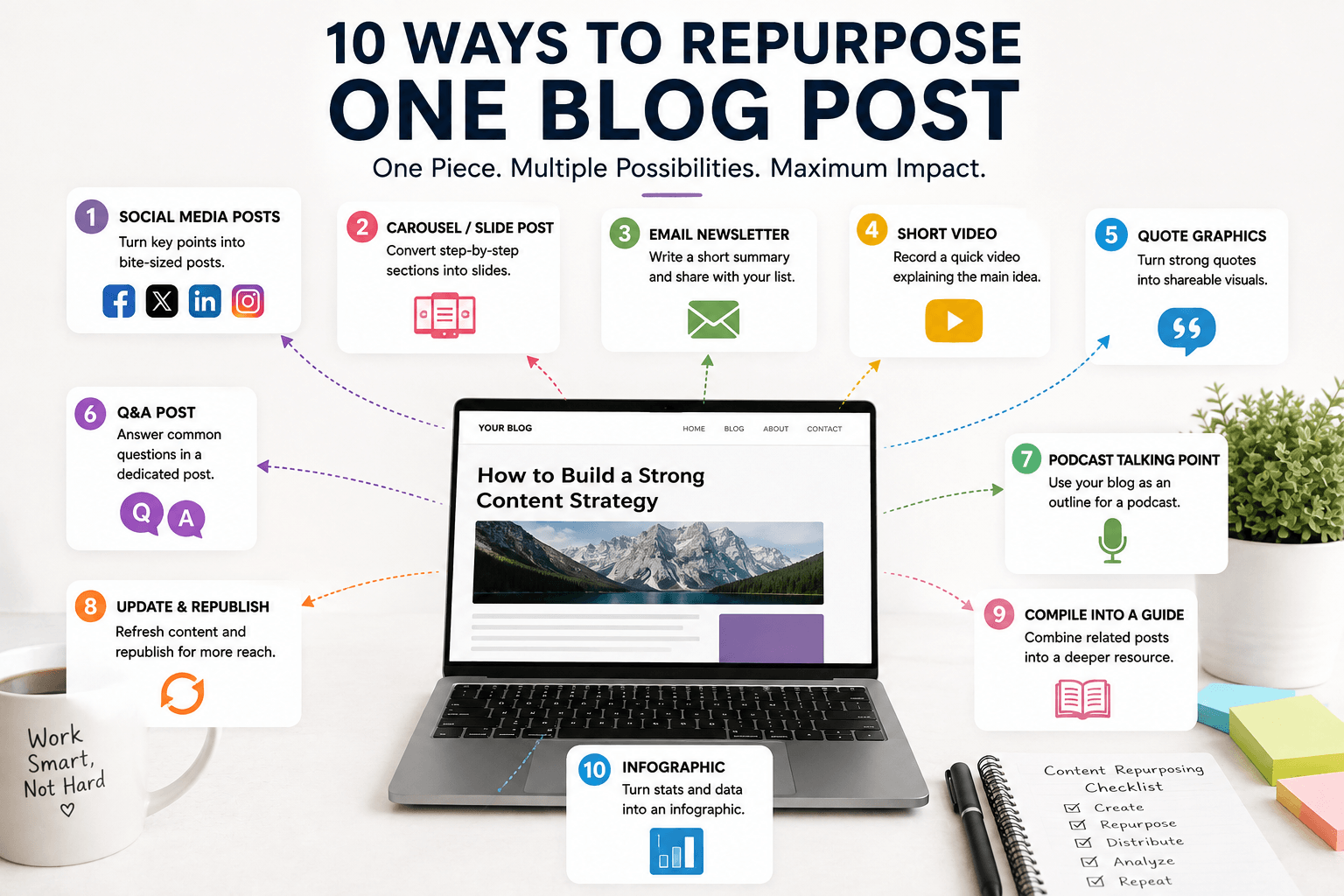
Content repurposing can help you create more content without constantly starting from scratch. Yet many creators believe every platform needs brand-new content, leaving them overwhelmed, burned out, and struggling to stay consistent.
Zoya, a content marketer, faced this exact challenge. Every week, she wrote one in-depth blog post, then spent hours creating separate content for social media, email newsletters, and short videos. Despite all that effort, her traffic grew slowly, and keeping up with content demands felt impossible.
At first, Zoya thought the only solution was to publish more original content. But she soon realized the real answer wasn’t creating more—it was getting more value from the content she had already produced. One well-written blog post contained enough ideas to fuel an entire week’s worth of content across multiple platforms.
In this guide, you’ll learn how content repurposing works, how to turn a single blog post into ten high-value content pieces, and the simple workflow Zoya uses to increase traffic, save time, and stay consistent without burning out.
Learn more
Content Marketing in 2026 (Complete Strategy Guide That Actually Works for Traffic & Sales)
Why Content Repurposing Solves the Content Treadmill Problem
Creating fresh content for every platform separately takes enormous time and energy.
Here’s what most creators overlook:
- One well-researched blog post already contains multiple smaller ideas
- Different platforms favor different content formats, not different topics
- Repurposed content still reaches new audiences who missed the original
Zoya’s blog posts were already full of useful insights. She just wasn’t extracting them into separate, platform-ready pieces.
Learn more
Content Marketing Examples in 2026: What Works and Why Most Blogs Fail
Content Repurposing: How to Turn One Blog Post Into 10 Content Pieces
Here’s exactly how Zoya breaks down a single blog post now.
1. Turn Key Points Into Social Media Posts
Each major point in your blog can become its own standalone social post.
Do this: Pull three to five key takeaways and turn each into a short, platform-specific post.
2. Create a Carousel or Slide Post
Step-by-step sections translate naturally into visual, swipeable content.
Do this: Convert any numbered list or process into a simple carousel format.
3. Write a Short Email Newsletter Summary
Your subscribers may never see the blog unless you bring it to them directly.
Do this: Summarize the core idea in a short email, linking back to the full post.
4. Record a Short Video Explaining the Main Idea
Some audiences prefer watching over reading.
Do this: Record a two-to-three-minute video covering the blog’s main takeaway.
5. Pull Quotes Into Standalone Graphics
Strong statements or stats make simple, shareable visual content.
Do this: Design one or two quote graphics using your most compelling lines.
6. Turn the Topic Into a Q&A Post
Common questions from the blog can become a separate, focused piece.
Do this: List the top questions your blog answers, and create a dedicated Q&A post.
7. Create a Podcast Talking Point
If you host or guest on podcasts, blog topics make ready-made discussion material.
Do this: Use your blog’s structure as an outline for a related podcast segment.
8. Update and Republish for SEO
Blog posts can be refreshed and reshared as new content over time.
Do this: Update statistics or examples every few months, then repromote the post.
9. Compile Related Posts Into a Guide
Multiple related blog posts can combine into one larger resource.
Do this: Group three or four related posts into a downloadable guide or resource page.
10. Turn Statistics Into an Infographic
Data-heavy sections work well as standalone visual content.
Do this: Pull key numbers into one clean, simple infographic design.
Learn more
Content Marketing Metrics in 2026: How to Measure What Actually Works
The M.U.L.T.I.P.L.Y Method for Content Repurposing
A simple way to remember this system is the M.U.L.T.I.P.L.Y method:
- Main idea – identify the single core message of your blog
- Unpack – break it into smaller standalone points
- Layout – match each point to the right format and platform
- Timing – space out repurposed pieces over several days
- Individual – tailor tone slightly for each platform’s audience
- Promote – link back to the original post wherever possible
- Loop – reuse strong performers again after a few months
- Yield – track which repurposed formats bring the most traffic back
Many creators only discover this system after realizing their best-performing content was published once, then never used again.
How Zoya Structured Her Content Repurposing Workflow
Zoya didn’t repurpose everything manually each week. She built a simple, repeatable process.
Here’s what she now does after publishing each blog post:
- Extracts three to five key points for social media posts.
- Creates one carousel and one quote graphic from the content.
- Writes a short email summary linking back to the full post.
- Records a short video covering the main takeaway.
This single workflow now produces a full week of content from one original piece.
What Changed After Zoya Started Repurposing Content
Since building this system, Zoya noticed a clear shift in her workflow and results.
- Her weekly content workload became far more manageable, without sacrificing consistency.
- Traffic to her original blog posts increased, since repurposed pieces consistently linked back.
- Audiences on different platforms started discovering her work who had never seen the original post.
This mirrors what many content strategists describe: repurposing doesn’t dilute content, it extends the reach of ideas that already proved valuable once.
Conclusion: Let Content Repurposing Multiply Your Efforts
Content repurposing isn’t about creating more work. It’s about extracting more value from work you’ve already done.
Start with one blog post, and turn just three of its key points into separate pieces this week.
Like Zoya, you can turn a single piece of content into a steady stream of traffic-driving posts, without burning out trying to create something new every single day.
FAQs
A. It means transforming one piece of content, like a blog post, into multiple formats for different platforms and audiences.
A. With focused extraction, one detailed blog post can often create eight to ten separate pieces of content.
A. No. Repurposed content that links back to the original often drives more traffic and supports its search rankings.
A. Social media posts are usually the fastest, since key points from a blog translate directly into short standalone posts.
A. Revisit strong-performing posts every few months, both to update them and to create fresh repurposed pieces.