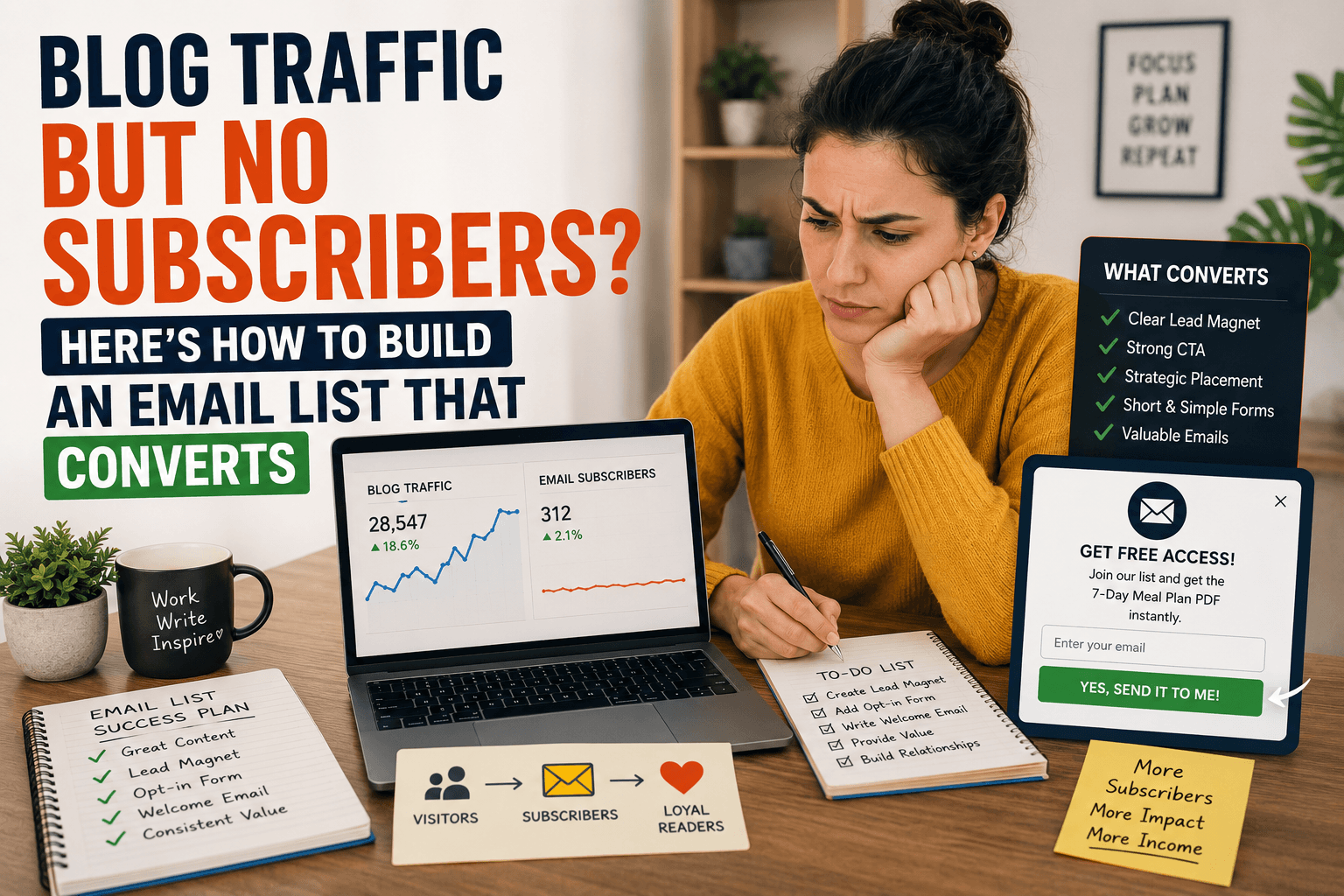
Blog email marketing can be frustrating when your website traffic keeps growing, but your subscriber count never moves. You check your analytics again. Traffic is up. Pageviews look great. But your email list is still stuck where it was three months ago.
That sting is real. You are doing the hard part—writing content people actually read—and still getting nothing back.
This is one of the most common problems in blog email marketing. Traffic and subscribers are not the same thing. One measures curiosity. The other measures trust. And trust takes a different strategy to earn.
In this article, you’ll learn exactly why this happens and how to fix it, step by step, using real examples that work.
Learn more
Start Blogging for Money in 2026: Beginner Guide
Why Blog Traffic Doesn’t Automatically Become Email Subscribers
Think of your blog like a busy street shop. People walk in, look around, and walk out. They liked what they saw. But nobody asked them to come back.
That is what happens without a strong email strategy. Readers enjoy your post. Then they leave. No signup form caught their attention. No reason was given to stay connected.
A study by OptinMonster found that the average website conversion rate for email signups is just 1% to 5%. That means for every 100 visitors, only a handful subscribe — unless you actively improve the system.
The Real Problem: Traffic Without a Plan
Most bloggers focus 90% of their energy on writing content. Only 10% goes into converting readers. That ratio needs to flip.
Good blog email marketing is not an afterthought. It is a system built into every post.
Learn more
Web Hosting WordPress: How to Choose the Best Domain and Hosting for Blogging
Blog Email Marketing Case Study: How One Food Blogger Grew Her List by 400%
Let’s look at a real example.
Sarah runs a home-cooking blog. She had over 20,000 monthly visitors but only 300 email subscribers. Frustrated, she made three changes:
- Added a recipe-card opt-in inside each post
- Offered a free “7-Day Meal Plan” PDF
- Placed the signup form above the fold, not just at the bottom
Within 90 days, her subscriber count jumped from 300 to over 1,500. Her traffic barely changed. Her strategy did.
This proves something important: you don’t need more traffic. You need a better system.
Learn more
High Bounce Rate on Your Blog? Here’s Why Visitors Leave Without Reading (2026 Fix)
Blog Email Marketing Tips to Build an Email List That Converts
Here are the exact steps that work, based on real blogging case studies and marketing data.
1. Give a Clear Reason to Subscribe
Nobody signs up for “updates.” That word means nothing.
Instead, offer something specific:
- A free checklist
- A short email course
- A discount code
- A downloadable template
This is called a lead magnet, one of the most important LSI keywords in email list building.
2. Place Signup Forms Where Readers Are Already Looking
Most blogs hide their signup form in the sidebar or footer. Nobody looks there.
Better placement options:
- Inside the content, after a helpful section
- At the end of the post, right when trust is highest
- As a simple slide-in box, not an aggressive popup
3. Keep the Signup Process Short
Ask for only an email address. Nothing else.
Every extra field — name, phone number, job title — lowers your conversion rate. Simplicity builds trust.
4. Use a Content Upgrade for Each Blog Post
A content upgrade is a bonus resource tied directly to the article someone is reading.
Example: If your post is about “meal planning,” offer a free printable meal planner. This is far more effective than a generic newsletter signup, because it matches exactly what the reader came for.
5. Follow Up With a Simple Welcome Email
The first email you send sets the tone.
Keep it short. Say thank you. Deliver what you promised. Ask one small question to start a conversation.
According to Campaign Monitor, welcome emails have an average open rate of 50%, much higher than regular newsletters. This is one of the most valuable applications of email marketing for bloggers.
Blog Email Marketing Mistakes That Stop People From Subscribing
Avoid these habits if you want your list to grow steadily:
- Asking for too much information upfront
- Using vague call-to-action text like “Subscribe Now”
- Hiding the signup form below the page
- Sending irregular or unclear follow-up emails
- Offering a lead magnet that doesn’t match the blog topic
Fixing even two or three of these can double your signup rate.
Build a Blog Email Marketing Strategy That Lasts
Growing an email list is not a one-time task. It is an ongoing habit.
- Review your top-performing blog posts monthly
- Add or update lead magnets based on what readers ask for
- Test different signup form placements
- Track your subscriber conversion rate, not just pageviews
Small, consistent improvements compound over time — just like Sarah’s 400% growth didn’t happen overnight, but through steady testing.
Conclusion: Turn Readers Into Subscribers, Not Just Visitors
Traffic tells you people are interested. An email list tells you people trust you enough to stay.
If your blog is getting visitors but no signups, the fix is not more content — it is a better blog email marketing system. Add clear lead magnets, simplify your signup forms, and follow up with real value.
Start with one change this week. Test it. Measure it. Then build from there. Your subscriber list will grow, one small improvement at a time.
FAQs
A. This usually happens because your blog lacks a clear reason for readers to subscribe, like a lead magnet or well-placed signup form. Traffic shows interest, but subscribers need a specific incentive to join.
A. A lead magnet is a free resource, like a checklist or template, offered in exchange for an email address. It gives readers immediate value and increases signup rates.
A. Place it within the content, right after a helpful section, and again at the end of the post. Avoid relying only on the sidebar or footer, since most readers skip those areas.
A. Keep it to just an email address whenever possible. Extra fields like name or phone number reduce conversion rates significantly.
A. Consistency matters more than frequency. Weekly or biweekly emails work well for most blogs, as long as each email delivers clear value to the reader.