
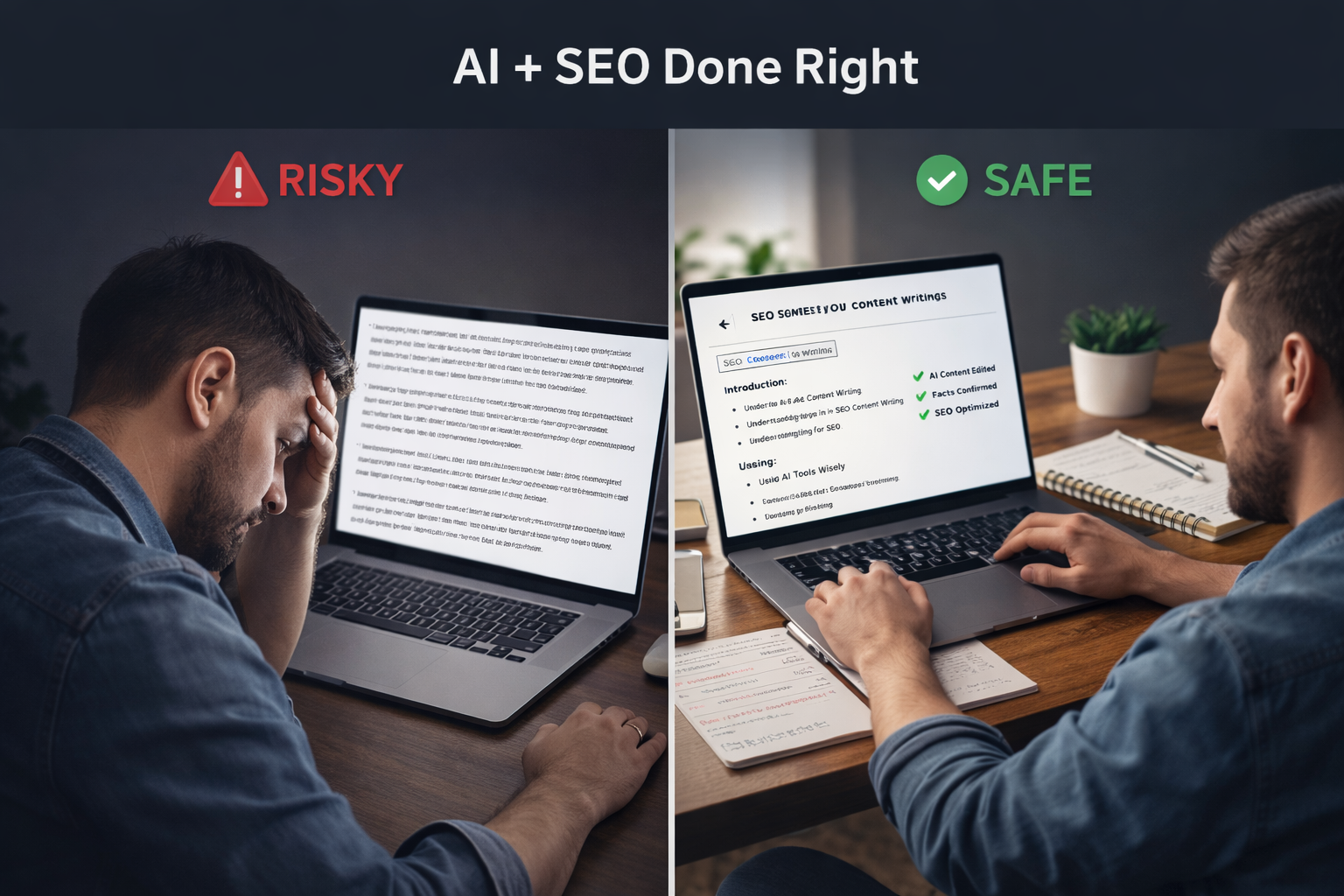
SEO content writing in 2026 feels confusing and risky. You use AI to work faster, but you worry Google might penalize your content.
That fear is real.
Many US freelancers ask the same question: “Will AI destroy my rankings?” The truth is simple. Google does not punish AI. It punishes low-quality content.
I have worked with freelancers who used AI the wrong way and lost rankings. I have also seen writers use AI as a support tool and increase organic traffic within 90 days. The difference was strategy.
Let’s break it down.
Why SEO Content Writing Rules Changed in 2026
Search engines are smarter now.
Google focuses on:
- Helpful content
- Real expertise
- Clear search intent
- User satisfaction
It does not matter if content is written by a human or AI. What matters is quality and value.
ALSO READ
What Gets Penalized in AI SEO Content Writing
Freelancers get into trouble when they:
- Copy AI output without editing
- Publish generic blog posts
- Ignore search intent
- Overuse keywords
- Skip fact-checking
AI tools generate text fast. But speed does not equal strategy.
Low-effort content looks the same across many websites. That is what search engines reduce in rankings.
What Does NOT Get Penalized in SEO Content Writing
Google’s public guidance says automation is allowed if content is helpful.
Safe practices include:
- Using AI for outlines
- Generating ideas
- Drafting first versions
- Improving readability
When you add human insight, examples, and research, you strengthen SEO content writing instead of harming it.
Real Example: Freelancer Workflow Shift
A US freelance writer created 25 AI blog posts in two months. Traffic did not grow.
We changed the workflow:
- Use AI for structure only
- Add real examples from client work
- Improve headlines for search intent
- Optimize internal linking
Within three months, impressions increased by 38%. The content was not rewritten from scratch. It was improved with expertise.
The Smart AI Framework for SEO Content Writing
Here is a simple system freelancers can follow in 2026.
Step 1: Start with Keyword Research
Before writing, define:
- Primary keyword
- Search intent
- Competitor gaps
AI cannot replace strategy.
Step 2: Use AI for Structure, Not Authority
Ask AI to:
- Create outlines
- Suggest subtopics
- Generate drafts
Then rewrite sections in your voice. Add real insight.
Step 3: Add Experience and Proof
Search engines value EEAT signals.
Include:
- Personal results
- Client case examples
- Data references
- Practical steps
This builds trust.
Step 4: Optimize for Search Intent
Every blog should answer one main question clearly.
For example:
Instead of “SEO Tips,” write “How Freelancers Can Improve Blog Rankings in 2026.”
Specific topics rank better.
Step 5: Edit Like a Human
Before publishing:
- Remove repetitive phrases
- Fact-check claims
- Improve clarity
- Add internal links
Editing separates professionals from automated spam.
Common AI Mistakes in SEO Content Writing
Avoid these errors:
- Publishing unedited AI drafts
- Ignoring audience tone
- Writing for bots instead of users
- Stuffing keywords
Freelancers who treat AI as a shortcut often lose authority.
Why US Freelancers Must Adapt
Competition is intense in 2026. Clients expect results.
AI can:
- Save time
- Improve productivity
- Generate ideas
But only skilled freelancers can turn AI drafts into high-performing SEO content writing pieces.
Think of AI as an assistant, not a replacement.
Quick Checklist Before Publishing AI Content
Use this checklist:
- Does it solve a real problem?
- Is search intent clear?
- Did you add original insight?
- Is it factually correct?
- Does it sound human?
If yes, you are safe.
ALSO READ
Difference Between Content Marketing and Digital Marketing
Conclusion
SEO content writing in 2026 is not about avoiding AI. It is about using AI wisely.
Google rewards helpful, expert-driven content. It reduces low-quality, automated spam.
If you combine AI efficiency with human insight, your SEO content writing can rank, build trust, and attract clients.
Use AI as a tool. Stay strategic. Focus on value.
That is how freelancers win.
FAQs
A. AI content can hurt rankings if it is low quality or unedited. Helpful and well-optimized content is safe.
A. Yes. Google allows automation as long as the content provides value and meets quality standards.
A. Use AI for outlines and drafts, then add human insight, examples, and optimization before publishing.
A. Publishing generic AI output without editing or adding expertise.
A. Google focuses on content quality, not detection. Low-value content is reduced, regardless of how it was created.