Email marketing for small business sounds simple. Build a list. Send emails. Make money.
But in 2026, many US business owners are staring at open rates and wondering why revenue is flat.
It feels confusing. You have subscribers. You send campaigns. Yet sales barely move.
I’ve worked with service businesses, eCommerce brands, and local companies that had thousands of subscribers but weak returns. Once we fixed their strategy, revenue per subscriber increased within 60–90 days. The issue was not the list size. It was the system.
Let’s break down what is going wrong and how to fix it.
ALSO READ
Why Email Marketing Still Works in 2026
Email Marketing for Small Business Is Failing in 2026
The inbox is crowded.
Customers receive:
- Promotional emails
- AI-generated newsletters
- Daily discount offers
Attention is limited. Trust is lower. Generic emails get ignored.
Many small businesses make the same mistakes:
- Sending only promotions
- Not segmenting their list
- Ignoring automation
- Writing boring subject lines
- Measuring opens instead of revenue
Email marketing must evolve.
Email Marketing for Small Business: Why Open Rates Don’t Mean Revenue
In the past, high open rates looked impressive.
But today:
- Privacy changes hide accurate open data
- Click-through rate matters more
- Revenue per subscriber is the real metric
A US clothing brand had a 32% open rate but low sales. After adjusting email content to include product education and stronger offers, revenue per campaign increased by 28% without growing the list.
Focus on money, not vanity metrics.
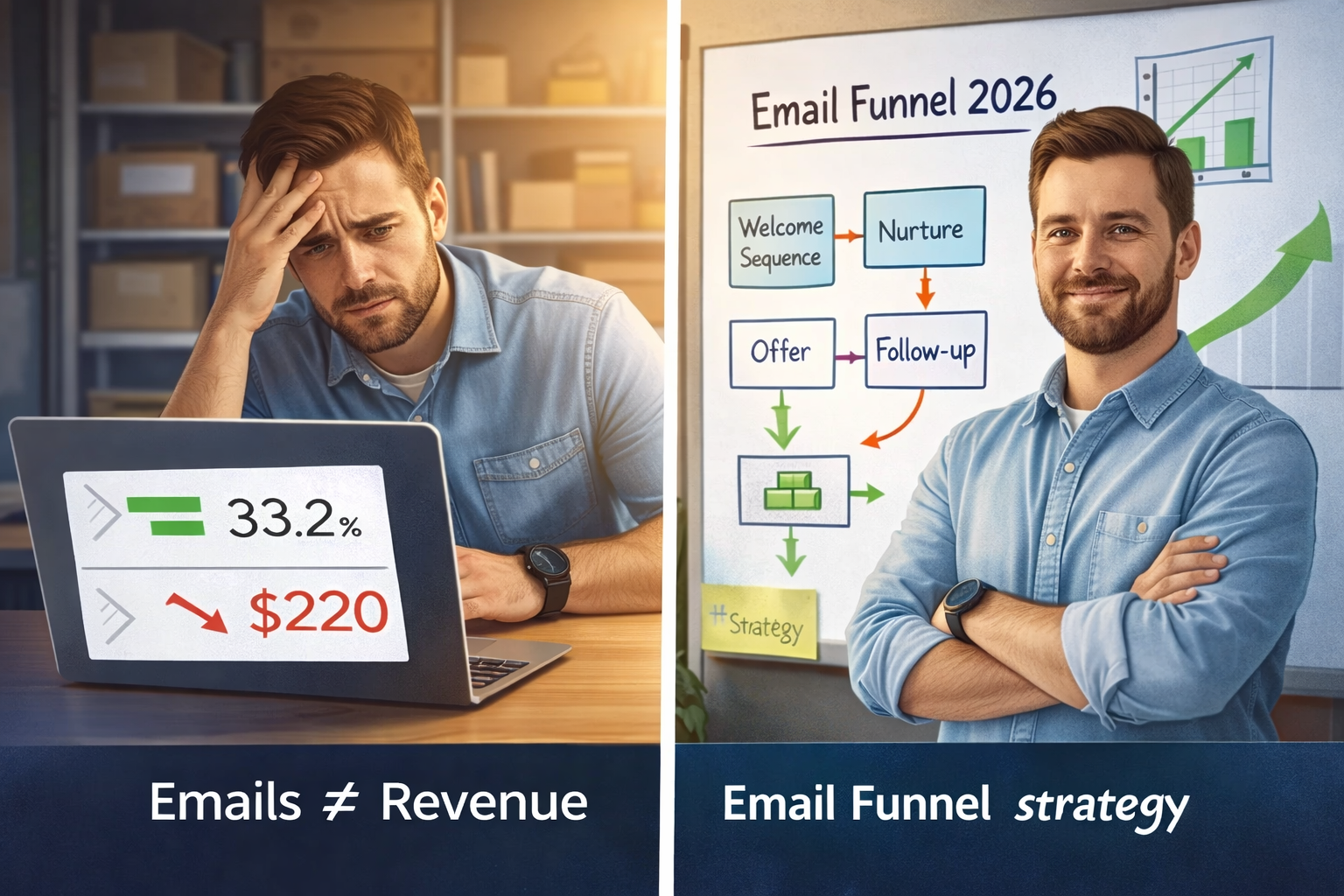
Problem #1: No Clear Email Funnel
Many small businesses send random emails.
There is no structure.
Effective email marketing for small business needs:
- Welcome sequence
- Nurture emails
- Offer-driven campaigns
- Re-engagement emails
Without a funnel, subscribers lose interest.
Problem #2: Weak Segmentation
Not all subscribers are the same.
Segment by:
- New subscribers
- Past buyers
- Interested prospects
- Inactive users
Targeted emails perform better than mass broadcasts.
One US service provider segmented their list by service type. Conversion rates improved within one quarter.
Problem #3: No Value Before Selling
If every email says “Buy now,” people unsubscribe.
Add:
- Educational tips
- Case studies
- Short insights
- Helpful resources
Value builds trust. Trust drives revenue.
What Actually Works in Email Marketing for Small Business in 2026
Let’s shift to solutions.
Step 1: Build a Simple Automation Flow
Start with:
- 5-email welcome sequence
- Story + value + soft offer
- Clear call-to-action
Automation works even when you are busy.
Step 2: Improve Your Offer
Sometimes the issue is not email. It is the offer.
Ask:
- Is this relevant to my audience?
- Is the benefit clear?
- Is there urgency?
Clear offers convert better.
Step 3: Focus on Revenue Per Subscriber
Track:
- Revenue per email
- Conversion rate
- Click rate
Stop obsessing over open rates.
Step 4: Use Personalization
Even simple personalization helps:
- First name
- Relevant product suggestions
- Location-based offers
Small touches improve engagement.
Step 5: Clean Your List Regularly
Inactive subscribers reduce deliverability.
Every 60–90 days:
- Remove unengaged contacts
- Send re-engagement emails
- Maintain list hygiene
Healthy lists perform better.
Real Example: Small US Brand Turnaround
A home decor brand had 4,200 subscribers. Revenue from email was inconsistent.
Changes made:
- Added structured welcome sequence
- Segmented by purchase behavior
- Sent educational content weekly
- Introduced limited-time offers
Within three months:
- Click rate increased by 22%
- Email-driven revenue grew by 35%
Same list. Better strategy.
Email Marketing for Small Business: Mistakes to Avoid in 2026
Avoid these errors:
- Buying email lists
- Sending daily promotions
- Ignoring mobile optimization
- Writing unclear subject lines
Email marketing rewards consistency and clarity.
Quick Action Checklist
Use this plan today:
- Audit your current funnel
- Create a welcome sequence
- Segment your list
- Improve your offer
- Track revenue metrics
Small improvements create big results.
Conclusion Email Marketing for Small Business
Email marketing for small business is not dead in 2026. It just requires a smarter strategy.
If your list is not making money, the issue is not your subscribers. It is your structure, segmentation, and offer.
Build a funnel. Provide value. Track real revenue.
Start with one improvement this week. Watch the difference.
FAQs
A. Most small businesses lack segmentation and a clear funnel. Structure and value improve conversions.
A. Consistency matters more than frequency. Start with 1–2 valuable emails per week.
A. Yes. With automation, personalization, and strong offers, email remains a powerful channel.
A. Revenue per subscriber and conversion rate matter more than open rates.
A. Absolutely. Automation ensures consistent communication and increases long-term revenue.