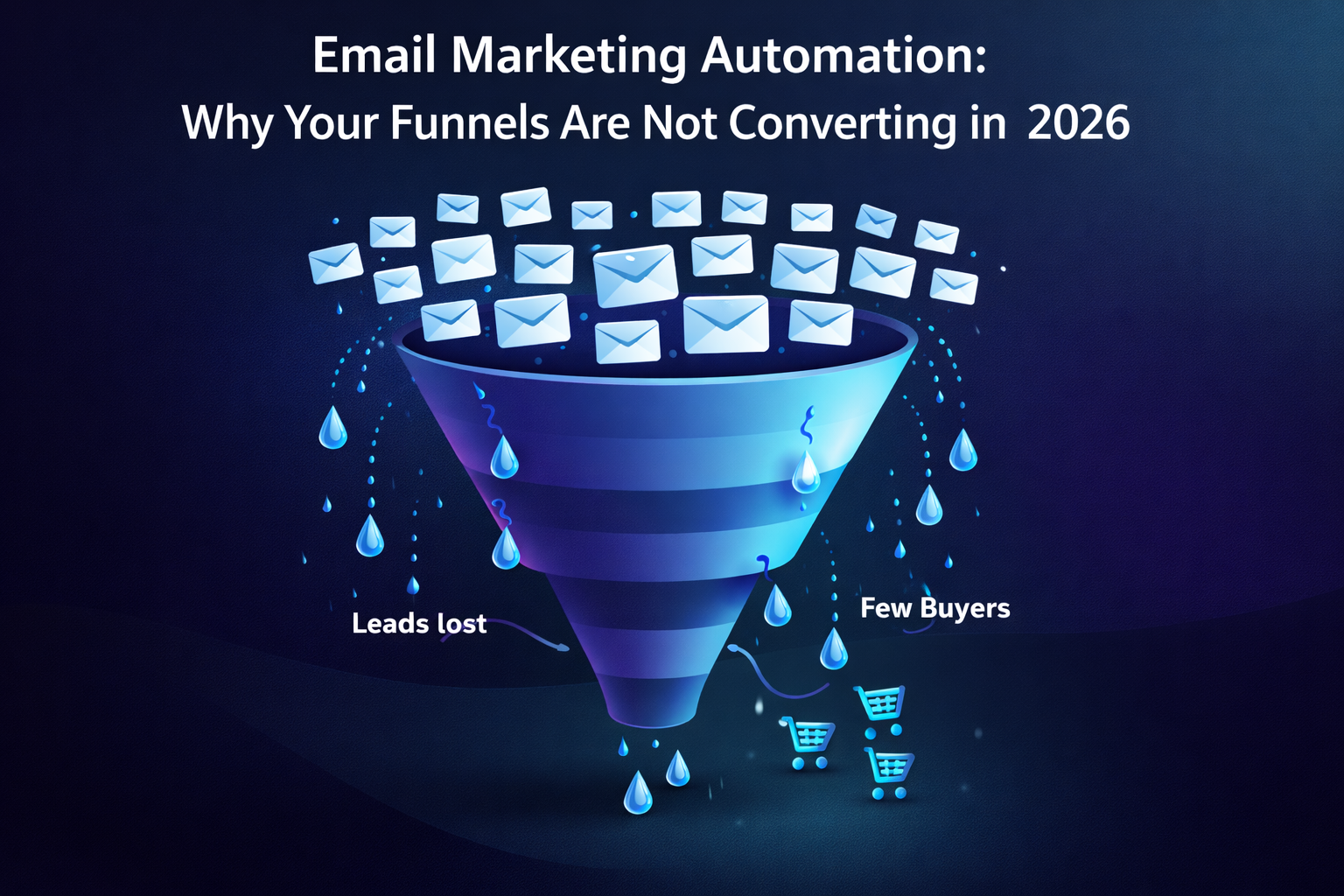
email marketing automation is supposed to save time and increase sales. Yet many businesses are frustrated because their automated funnels generate clicks but no real conversions.
Imagine building an automated email sequence, watching people open your emails, and still seeing very few purchases. The problem is rarely automation itself. The real issue is hidden funnel leaks that break the customer journey.
Understanding how automated email funnels works in modern marketing funnels can help businesses fix these leaks and dramatically improve conversions.
Email Marketing Automation: Why Funnels Fail in 2026
Many businesses believe that once automation is set up, results will happen automatically. Unfortunately, that assumption often leads to poor performance.
Successful email marketing automation requires strategy, testing, and constant improvement.
Common reasons automation funnels fail include:
- weak targeting
- irrelevant content
- poor timing of emails
- broken funnel structure
When these problems appear, subscribers lose interest quickly.
ALSO READ
Email Marketing Segmentation Strategy in 2026: How Small Businesses Double Revenue
Email Marketing Automation Mistakes That Kill Conversions
Even well-designed funnels can fail when small mistakes go unnoticed.
Poor Audience Segmentation
Sending the same automated emails to everyone rarely works.
Different subscribers have different needs.
For example:
- new subscribers need education
- returning customers want offers
- inactive users need re-engagement
Without segmentation, automated emails feel generic and ineffective.
Weak Value Proposition
Many automated email funnels push products too early.
Subscribers need to understand why your solution matters before they consider buying.
A strong funnel provides:
- useful insights
- practical advice
- real solutions to problems
Value builds trust before the sales message appears.
Poor Email Timing
Timing plays a major role in automation success.
Sending emails too frequently can annoy subscribers. Sending them too rarely can make people forget your brand.
Effective funnels maintain a balanced schedule that keeps subscribers engaged.
Hidden Funnel Leaks in Automated Email Campaigns
Some funnel problems are difficult to detect but damage conversion rates significantly.
Confusing Customer Journey
If subscribers do not clearly understand what to do next, they often leave the funnel.
Every email should guide readers toward a clear action such as:
- reading a guide
- watching a demo
- claiming an offer
Clear direction improves engagement.
Generic Email Content
Generic automation sequences often feel robotic.
Subscribers respond better when emails feel personal and conversational.
Using personalization such as:
- subscriber names
- behavior-based recommendations
- relevant resources
makes automation more effective.
Email Marketing Automation Case Study: Fixing a Broken Funnel
A small digital marketing agency built a five-email automated funnel to sell its SEO training program.
However, the results were disappointing.
The Problem
Campaign analytics showed:
- open rate: 29%
- click rate: 8%
- sales conversion: less than 1%
Subscribers were reading emails but not buying.
The Funnel Fix
After reviewing the automation strategy, the company made three important changes.
- Improved email segmentation
- Added educational content before promotions
- Simplified the call-to-action
The Results
Within two months, the funnel performance improved significantly.
- conversion rate increased to 4%
- engagement remained high
- automated sales doubled
This example shows how small improvements can transform email marketing automation results.
Strategies to Improve Automation Funnel Conversions
Businesses can improve funnel performance by applying simple but powerful strategies.
Email Marketing Automation Strategy: Focus on Customer Problems
Subscribers respond when emails address real challenges.
Helpful content may include:
- step-by-step guides
- expert insights
- industry updates
When emails solve problems, trust grows.
Email Marketing Automation Strategy: Use Clear Calls-to-Action
Every automated email should guide readers toward a specific action.
Strong calls-to-action include:
- “Download the guide”
- “Start your free trial”
- “Watch the demo”
Clear direction increases conversions.
Email Marketing Automation Strategy: Continuously Test and Improve
Successful marketers constantly analyze funnel performance.
Testing can include:
- different subject lines
- email timing
- message structure
Small improvements often produce large results over time.
ALSO READ
Why Your Email Subscribers Don’t Trust You in 2026 (And How to Fix It)
Conclusion
Many businesses assume automation will automatically generate sales. In reality, successful email marketing automation requires careful strategy and optimization.
Hidden funnel leaks such as poor segmentation, weak messaging, and confusing customer journeys can destroy conversion rates. By identifying these problems and improving the funnel structure, businesses can transform their automation performance.
When automation focuses on value, personalization, and clear communication, it becomes one of the most powerful tools for turning subscribers into customers.
FAQs
Email marketing automation uses automated workflows to send targeted emails based on subscriber behavior, actions, or timing.
Funnels often fail due to poor segmentation, weak messaging, confusing customer journeys, or poor email timing.
Businesses can improve conversions by providing valuable content, using clear calls-to-action, and optimizing their funnel structure.
Yes. Personalized emails often generate higher engagement and stronger customer relationships
Most businesses find success sending automated emails every few days while maintaining consistent engagement without overwhelming subscribers.