
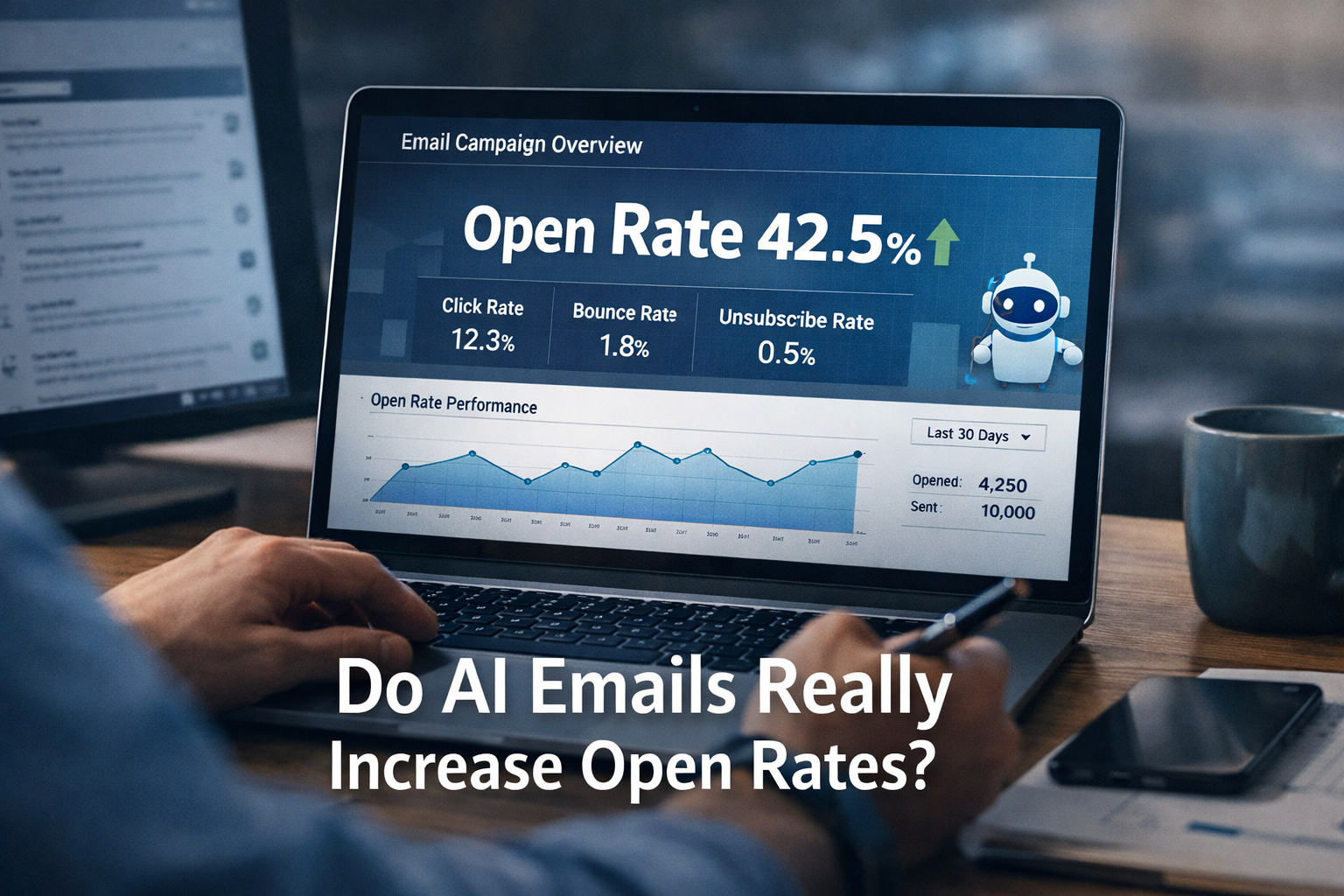
AI Written Emails are becoming a popular choice for busy marketers.
Email campaigns take time, and writing subject lines again and again can feel exhausting.
That’s why many teams turn to AI to speed up email writing and improve open rates. But do AI-written emails actually work in real inboxes? Let’s look at the reality based on testing, not hype.
Why Marketers Are Using AI Written Emails
Email inboxes are crowded. Standing out is hard.
Marketers use AI for emails because it promises:
- Faster email writing
- Better subject lines
- Data-based suggestions
- Less creative fatigue
On paper, it sounds perfect.
ALSO READ
Why Most Social Media Caption AI Tools Fail to Drive Engagement
How We Tested AI Written Emails
To avoid theory, we tested AI emails in real campaigns.
Testing setup:
- Same audience size
- Same sending time
- Same email offer
- One version written by AI
- One version edited by a human
The only change was the email copy.
Do AI Written Emails Improve Open Rates?
The short answer: sometimes.
In many cases, AI helped improve open rates slightly. But results were not consistent across all campaigns.
What mattered most was how AI was used, not just using it.
Where AI Written Emails Perform Well
1. Subject Line Ideas
AI is strong at generating multiple subject lines quickly.
It helps with:
- Variations for A/B testing
- Clear wording
- Removing guesswork
This alone can improve open rate testing speed.
2. Clarity Over Creativity
AI-written copy is usually:
- Clear
- Short
- Easy to understand
For informational emails, this works well.
Where AI Written Emails Fall Short
1. Lack of Emotional Connection
AI emails often feel correct but cold.
They miss:
- Curiosity
- Urgency
- Personal tone
Subscribers notice this quickly.
2. Generic Language
Without custom prompts, AI produces safe phrases.
This leads to:
- Predictable subject lines
- Low curiosity
- Average performance
Email opens depend heavily on feeling, not just logic.
Real Campaign Result Example
In one campaign test:
- AI-only email: moderate open rate
- Human-written email: slightly higher
- AI + human-edited email: best result
The winning version combined speed with human judgment.
Common Mistakes When Using AI for Email Writing
Many marketers expect too much from AI.
Mistakes to avoid:
- Sending AI emails without editing
- Using the same prompt every time
- Ignoring brand voice
- Chasing automation over connection
These mistakes reduce trust and engagement.
How to Use AI Written Emails the Right Way
Here’s what worked best in testing:
- Use AI to draft subject lines
- Edit tone manually
- Add personalization
- Test small changes
- Track results, not assumptions
AI should support decisions, not replace them.
AI Emails vs Human Emails (Quick Comparison)
| Factor | AI Only | Human + AI |
|---|---|---|
| Speed | Fast | Moderate |
| Emotion | Low | High |
| Consistency | High | Balanced |
| Open Rates | Mixed | Better |
The hybrid approach wins most of the time.
Are AI Written Emails Worth Using?
Yes — with realistic expectations.
They are worth using if you:
- Run frequent campaigns
- Test subject lines often
- Want faster drafts
They are not ideal if you:
- Skip human review
- Depend on automation alone
- Ignore audience behavior
Used wisely, AI-generated emails can support better email performance.
ALSO READ
AI Advertising Tools Tested: Which One Actually Converts Better Ads?
Conclusion
AI can help emails get opened, but it is not a magic switch.
The biggest gains came when marketers used AI for speed and humans for judgment. When combined correctly, AI Written Emails can increase efficiency without harming trust.
The key is balance, not blind automation.
FAQs
A. They are emails created using artificial intelligence to generate copy or subject lines.
A. They can, especially when combined with human editing and testing.
A. They help with structure, but personalization is still essential.
A. No. AI assists copywriters but does not replace strategic thinking.
A. Use AI for drafts and ideas, then refine messages manually before sending.