Content marketing tools can help small businesses save time, stay consistent, and compete with larger brands. It’s 11 p.m. You just closed your laptop after a 12-hour workday. Your blog hasn’t been updated in six weeks, and your competitor just posted their third reel this week.
If this sounds familiar, you are not alone. Every small business owner reaches a point where they need the right content marketing tools just to keep up.
The good news is that you don’t need a big team or a big budget. You just need the right content marketing tools, used the right way.
Learn more
Content Marketing in 2026 (Complete Strategy Guide That Actually Works for Traffic & Sales)
Why Small Businesses Struggle to Find the Right Content Marketing Tools
Most small business owners wear five hats at once. You are the founder, the marketer, the salesperson, and sometimes the delivery driver too.
Content marketing takes time. Writing blogs, designing graphics, scheduling posts, and tracking results — it adds up fast.
Here’s the real problem:
- You don’t have hours to spend learning complicated software.
- You can’t afford a full marketing agency.
- You need results, not just “activity.”
This is exactly why the right content marketing tools matter. They save time, cut costs, and help you show up consistently, even on your busiest days.
Learn more
SEO Content Writing in 2026: How US Freelancers Can Use AI Without Getting Penalized
What to Look for Before You Pick Content Marketing Tools
Before you download another app, ask yourself three simple questions:
- Does it solve a real problem I have today?
- Can I learn it in under an hour?
- Does it fit my budget for the next 12 months?
If the answer is yes to all three, it’s worth trying. If not, skip it. Too many tools create more confusion, not less.
Best Free Content Marketing Tools for Small Businesses
You can build a strong content system without spending a single rupee or dollar. Here are the top free picks for 2026.
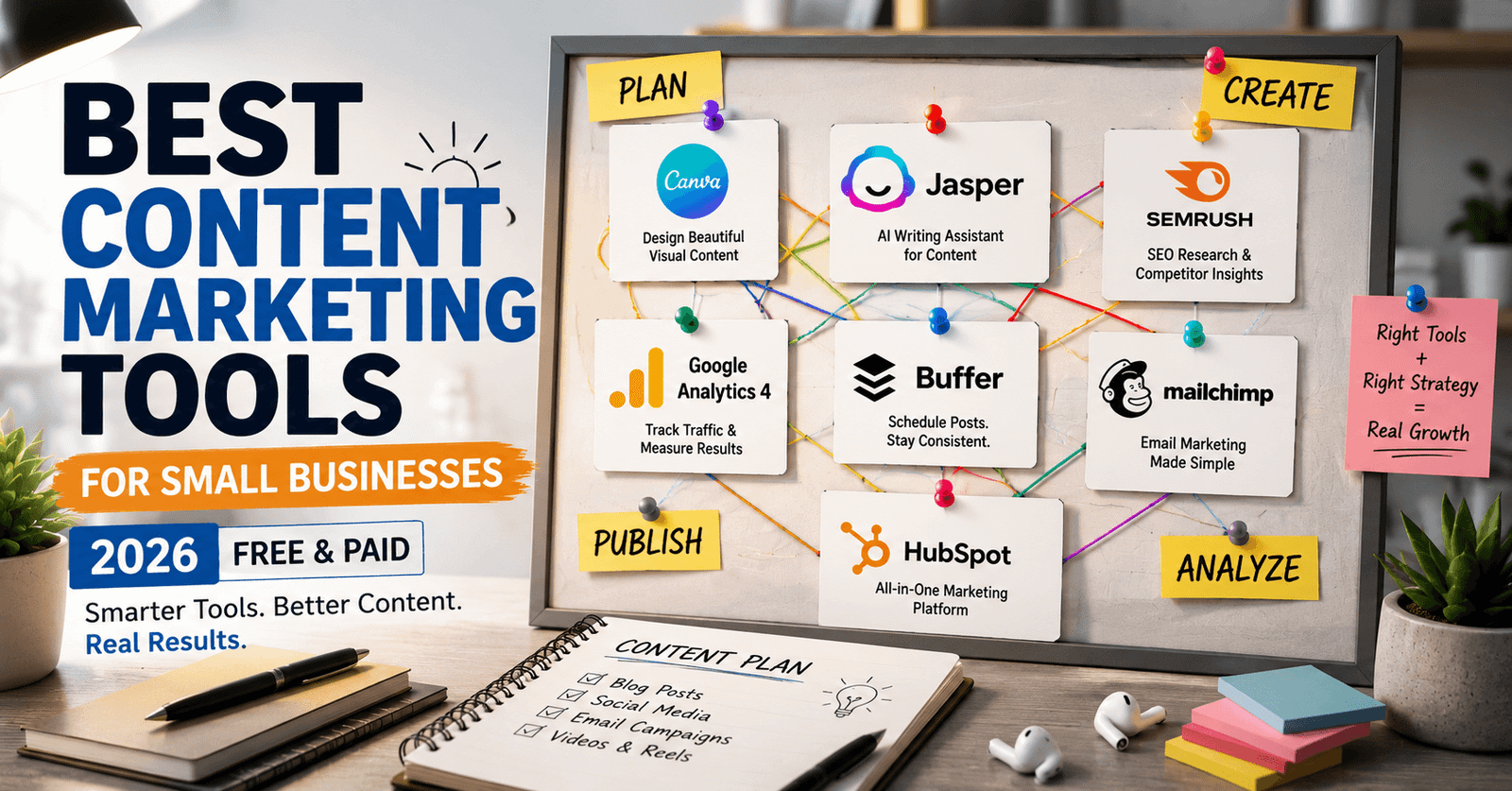
Canva – Best for Visual Content
Canva remains the easiest way to create professional graphics without a designer. It offers thousands of templates for social posts, flyers, and blog images.
The free plan covers most small business needs. You only need to upgrade if you want unlimited AI design features.
Google Analytics 4 – Best for Tracking Results
You can’t improve what you don’t measure. Google Analytics 4 (GA4) shows you exactly which content brings visitors and sales.
It’s completely free, and it connects easily with most websites.
Buffer – Best for Social Media Scheduling
Buffer lets you plan and schedule posts across platforms in advance. Its free plan is simple enough for solo founders and small teams.
Scheduling in advance means you stop scrambling every morning to think of a post idea.
Learn more
Conversion Rate Optimization: Why Your Website Gets Traffic But No Sales (2026 Fix)
Best Paid Content Marketing Tools for Small Businesses
Once your content starts working, paid tools help you scale faster with less manual effort.
Jasper – Best AI Writing Assistant
Jasper helps you draft blog posts, ad copy, and social captions in minutes instead of hours. Plans start around $49 per month.
It’s most useful when you need to publish content consistently but don’t have a full-time writer.
Semrush – Best for SEO Research
Semrush helps you find keywords your customers are actually searching for. It also shows what your competitors are ranking for.
Even the free version gives limited daily searches, which is enough for small content plans. Paid plans unlock deeper research.
Mailchimp – Best for Email Marketing
Your email list is one marketing asset you fully own. Mailchimp makes it easy to send newsletters and automate follow-ups.
The free plan covers small lists. Paid plans start low and grow as your list grows.
HubSpot – Best All-in-One Platform
HubSpot combines content management, SEO, and email marketing in one dashboard. It’s built to scale with you as your business grows.
It suits small businesses ready to move beyond scattered, separate tools.
How a Small Business Actually Solved This Problem
A small bakery owner in Texas once told her story online. She had no marketing budget and no design skills.
She started with just two tools: Canva for graphics and Buffer for scheduling. Within three months, her Instagram following doubled, and weekend orders increased.
She later added Mailchimp once her customer list grew past 200 people. That’s the real lesson here — start small, add tools only when you actually need them.
Quick Comparison Table
| Tool | Best For | Free Plan? | Starting Paid Price |
|---|---|---|---|
| Canva | Design | Yes | Paid plans available |
| GA4 | Analytics | Yes | Free |
| Buffer | Scheduling | Yes | From ~$6/month |
| Jasper | AI Writing | No | From ~$49/month |
| Semrush | SEO Research | Limited | From ~$38/month |
| Mailchimp | Email Marketing | Yes (small lists) | From ~$13/month |
| HubSpot | All-in-One | Limited | Custom pricing |
Common Mistakes to Avoid When Choosing Content Marketing Tools
Even smart business owners make these mistakes:
- Buying too many tools at once. Start with one or two, then add more.
- Ignoring the learning curve. A powerful tool you never open is wasted money.
- Choosing tools without a clear goal. Always match the tool to a real problem.
- Skipping free trials. Test before you commit to a yearly plan.
Avoiding these mistakes saves both time and money.
Conclusion
Running a small business is already hard enough. The right content marketing tools shouldn’t add to that stress — they should take weight off your shoulders.
Start with one free tool this week. Master it. Then add the next one only when you truly need it. Small, steady steps build strong marketing systems that last.
Your content doesn’t need to be perfect. It just needs to show up, consistently, in front of the right people.
FAQs
A. Canva, Google Analytics 4, and Buffer are great starting points. They cover design, tracking, and scheduling without any cost.
A. Not at first. Start free, and upgrade only when your content volume or team grows beyond what free plans allow.
A. Semrush is one of the strongest choices for keyword research and competitor tracking, even on its limited free plan.
A. Not fully. AI tools speed up drafting, but a human touch still improves tone, accuracy, and brand voice.
A. Two or three well-chosen tools are usually enough. Focus on solving one problem at a time instead of collecting apps.